

20 Best Things to Do in Berlin: The Ultimate 2026 Travel Guide
Discover the 20 best things to do in Berlin, from the Brandenburg Gate to hidden local markets. Includes expert travel tips, free activities, and what to skip.
On this page
20 Best Things to Do in Berlin
After my seventh visit to Berlin this past spring, I still find new layers to this complex city. Berlin is a destination that never stops evolving, blending a heavy history with a vibrant, modern energy. Whether you are here for the world-class museums or the legendary nightlife, the German capital always delivers.
Last refreshed June 2026 following research across multiple neighborhoods from Mitte to Neukölln, this guide covers all pricing and entry requirements as they stand today. Choosing the Best Time to Visit Berlin: Seasonal & Monthly Guide depends on your love for festivals or cozy winter markets.
This list mixes world-famous landmarks with the gritty local spots that define Berlin's soul. I have included specific tips on how to save money and avoid the most common tourist mistakes. Get ready to explore everything from Cold War relics to lush urban parks across this sprawling metropolis.
Key Takeaways
- Quick pick (Best Overall): The Berlin Wall Memorial at Bernauer Straße for its authentic history.
- Quick pick (Best for Families): Tempelhofer Feld for its massive open space and cycling paths.
- Quick pick (Best Free Activity): The East Side Gallery murals and the Topography of Terror museum.
- Quick pick (Best Rainy-Day): A day pass for Museum Island to explore five world-class institutions.
- Essential Tip: Always validate your train ticket in the platform boxes to avoid heavy fines.
Visit the Iconic Brandenburg Gate
The Brandenburg Gate is the most recognizable symbol in the city and worth every visit, even on a repeat trip. Built over 230 years ago, it stands on Pariser Platz at the edge of the Tiergarten, right where the Berlin Wall once divided the city. Entry to the square is free, and the gate never closes — visit at sunrise to photograph it without the midday crowds.
The surrounding area rewards a longer look. The nearby Memorial to the Murdered Jews of Europe is a five-minute walk south, and the Reichstag is visible to the northeast. If it is your first time, joining a walking tour here adds real historical depth. Guides can explain how this gate became the flashpoint of reunification in November 1989 in a way that standing in front of it alone cannot.
Climb the Reichstag Dome for Panoramic Views
The glass dome on top of the Reichstag offers some of the best 360-degree views in the city, and admission is completely free. The catch is that you must register in advance on the Bundestag's official website — walk-in entry is not available. Slots fill several weeks ahead during summer, so book as soon as your travel dates are confirmed.
Book your free Reichstag dome reservation several weeks in advance during April–September. Summer slots fill quickly and walk-ins are never allowed, even at the door.
Inside the dome, a mirrored cone channels natural light into the parliamentary chamber below. There is also a rooftop restaurant, Käfer, which requires a separate reservation. Booking dinner there is a legitimate way to experience the rooftop with a shorter security queue than the dome entrance. The Soviets left original wartime graffiti on parts of the building's walls — ask the audio guide where to find it, because it is genuinely striking.
Walk the Berlin Wall Memorial & East Side Gallery
These are two different sites and both are essential. The Berlin Wall Memorial at Bernauer Straße is the more serious of the two — the original death strip, watchtowers, and documentation center are preserved here, and the outdoor grounds are free to enter until 22:00. Climb the observation tower to look down at the full width of what the border actually was: not a single wall but a fortified corridor of fencing, searchlights, and sand.
The East Side Gallery is 4 km south and a completely different experience. This 1.3-kilometer stretch of the original wall was painted by 105 artists from around the world in 1990 and remains the longest open-air gallery in Europe. Walk it from the Ostbahnhof end toward Warschauer Straße for the best flow. It is free and open 24/7. For deeper context on both sites, consider a guided Cold War walking tour, which typically combines the Wall with Checkpoint Charlie and the Tränenpalast in a three-hour loop.
Explore Museum Island UNESCO World Heritage Site
Museum Island packs five major institutions into a small island in the Spree: the Altes Museum, Neues Museum, Alte Nationalgalerie, Bode Museum, and the Pergamon Museum. Even if museums are not your priority, the island is worth visiting just for the architecture and the adjacent Berlin Cathedral (Berliner Dom). Our Museum Island guide covers each institution in detail, including which ones to prioritize on a half-day.
The Pergamon Museum stands out. It houses the Ishtar Gate of Babylon and the Market Gate of Miletus — full ancient structures transported stone by stone to Berlin. The scale is genuinely hard to process. Day passes cost around €22, though individual tickets range from €12 to €16. Most museums open at 10:00 and close at 18:00, with extended hours on Thursdays. Almost all are closed on Mondays, so plan accordingly. The Museum Pass Berlin covers all five for three consecutive days and saves money if you plan more than one visit.
Reflect at the Holocaust Memorial
The Memorial to the Murdered Jews of Europe is a field of 2,711 concrete stelae of varying heights that cover an entire city block near the Brandenburg Gate. Walking into the center of the grid, the sounds of traffic fade and the scale becomes disorienting — the ground slopes unevenly and the columns tower above you. It is free to enter and accessible at all hours.
The underground information center beneath the memorial is a separate, more structured experience. It is open 10:00 to 18:00 and contains individual stories, family histories, and documentation of the systematic nature of the Holocaust. Visit the memorial first for the emotional impact, then go underground for the historical framework. Do not climb the stelae — it is disrespectful and security guards enforce this actively.
Learn History at the Topography of Terror
The Topography of Terror sits on the exact ground where the Gestapo headquarters and SS command were located. The indoor museum documents the crimes of the Nazi regime in chilling detail — original photographs, documents, and testimony that cover the full machinery of terror. The outdoor section runs along a preserved stretch of the Berlin Wall and traces the rise of the regime from 1933 onward.
Both sections are free to visit. The museum is open daily from 10:00 to 20:00, which makes it one of the most generous opening windows in the city. Allow at least two hours; most visitors significantly underestimate how long the indoor exhibition takes. This is one of the most visited museums in Germany, and for good reason — there is no equivalent site in Europe that places the perpetrators, their headquarters, and their crimes so concretely in one location.
Relax at Tempelhofer Feld Airport Park
Tempelhof closed as an airport in 2008 and Berliners voted in 2014 to keep the entire airfield as public open space — defeating a development plan. The result is a 355-hectare park where the original runways are intact. Locals cycle them, rollerblade, fly kites, and do windsurf training on calm days. There are urban gardening plots where community groups grow vegetables in recycled containers along the perimeter.
Entry is free and the gates open from sunrise to sunset. This is one of the most genuinely local things you can do in Berlin — on a warm Sunday afternoon the runways fill with hundreds of people and the atmosphere is unlike any traditional park. Pack a picnic or grab something from the food carts near the main entrance. It is particularly good for families: the space is enormous, completely flat, and cars are banned entirely inside the grounds.
Shop the Mauerpark Sunday Flea Market & Karaoke
Mauerpark runs every Sunday from 09:00 to 18:00 on land that was once part of the Berlin Wall's death strip. The flea market covers most of the park — vintage clothing, GDR memorabilia, vinyl records, hand-crafted jewellery, and street food stalls all compete for space. Entry is free. Arrive before noon if you want first pick of the stalls before the afternoon crowds hit.
Bearpit Karaoke is the unexpected highlight. Every Sunday from 15:00, people queue to sing in front of hundreds of strangers in the park's stone amphitheater. The crowd is outrageously supportive — even genuinely terrible performances get cheered. It is chaotic, hilarious, and entirely free. Check the Bearpit Karaoke Instagram before you go, because it is canceled in bad weather. The whole Sunday combination — market in the morning, karaoke in the afternoon — is one of the best half-days in Berlin.
Tour the Charlottenburg Palace & Gardens
Charlottenburg Palace is the only surviving royal residence in Berlin and the city's answer to Versailles. The baroque architecture and formal gardens feel like a complete break from the concrete and history of central Mitte. It sits in the western district of Charlottenburg, about 30 minutes from the city center by U-Bahn.
Tickets for the palace interior cost around €19 for adults. The gardens are free to enter and open daily from 08:00 until dusk. Book tickets in advance during summer — the palace gets genuinely busy and queues at the door can add an hour to your wait. The orangery and the Belvedere teahouse in the gardens are worth seeking out even if you skip the main palace interior. Allow at least two hours for the full grounds.
See Checkpoint Charlie — Then Visit the Tränenpalast Instead
Checkpoint Charlie is historically important but the current site is a commercial operation. The replica guardhouse, actors posing in soldier uniforms for paid photos, and souvenir stalls surrounding the crossing make it feel more like a theme park than a memorial. If you visit — and you probably will, because it is centrally located — keep expectations calibrated. Read the outdoor information boards and move on rather than paying for the adjacent museum.
The Tränenpalast at Friedrichstraße S-Bahn station is the more authentic Cold War experience. This was the actual departure hall where East Germans said goodbye to family members crossing to the West — often the last time they would see them. The original building is intact, and the free permanent exhibition documents individual stories of separation, escape attempts, and the bureaucratic cruelty of the border regime. It is open daily from 09:00 to 19:00. The emotional weight here is genuine in a way that Checkpoint Charlie is not.
Take in the View from the Berlin TV Tower
The Fernsehturm at Alexanderplatz is 368 meters tall and provides the highest 360-degree panorama in the city. The observation deck is at 203 meters and on a clear day you can see as far as the Müggelsee lake in the east. Tickets cost around €25 to €30 depending on the time of day; the fast-track ticket is worth the premium to avoid the standard queue, which can stretch to 90 minutes in peak season.
The tower is open daily from 10:00 to 23:00. The rotating restaurant one level above the deck completes a full rotation every 30 minutes. Even if you skip the restaurant, the observation deck alone justifies the price as a quick orientation tool on your first morning in the city. It shows you how Berlin's neighborhoods relate to each other spatially in a way that maps do not convey.
Enjoy a Scenic Spree River Boat Cruise
A boat tour on the Spree offers the most relaxed way to see the government district, Museum Island, and the historic center without walking a kilometer between each site. One-hour cruises typically cost between €18 and €25 per person. Most boats depart every 30 minutes from docks near Friedrichstraße station and the Nikolaiviertel, from 10:00 to 18:00 daily from April through October.
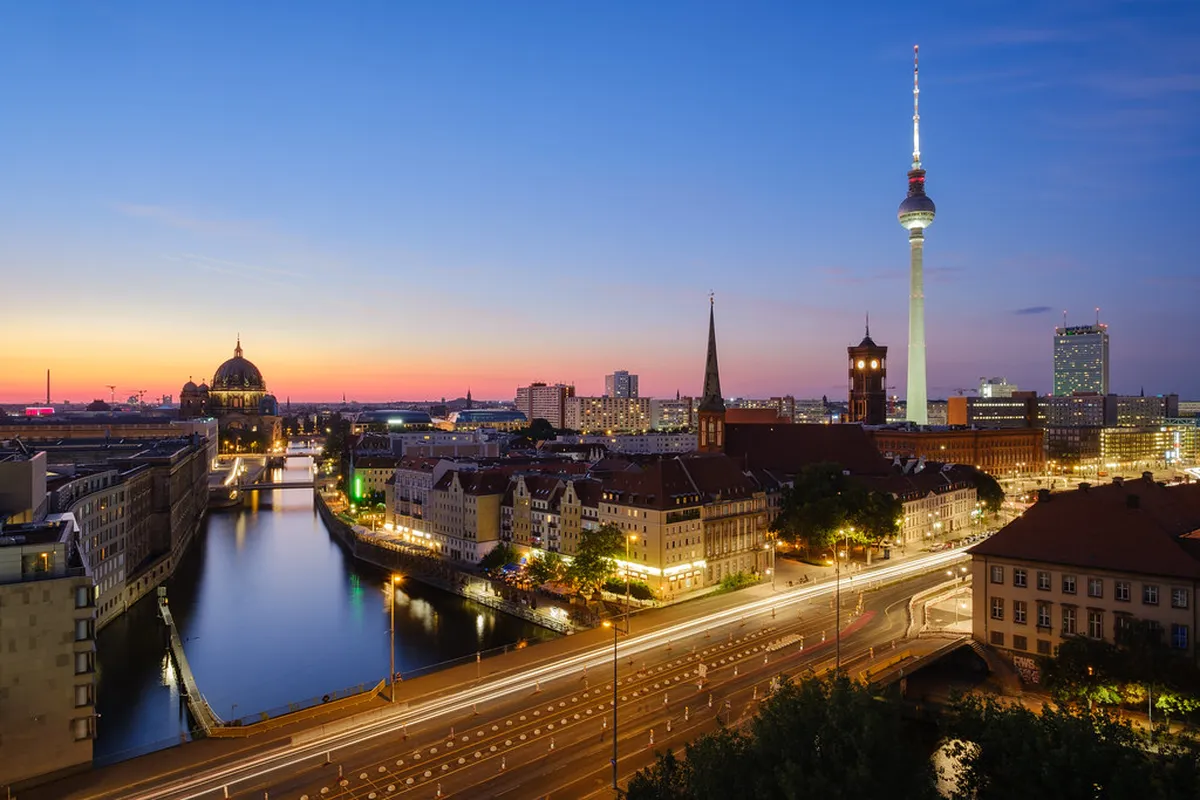
Evening cruises are particularly good in summer — the Reichstag, Berlin Cathedral, and Humboldt Forum are all lit from the water side. Some operators offer multi-hour tours that extend as far as Charlottenburg Palace via the Landwehrkanal. If the weather is marginal, most boats have enclosed decks but the best views come from the open upper level. Book in advance on weekends in July and August.
Discover Kreuzberg's Food and Street Art
Kreuzberg is the most concentrated expression of everything that makes Berlin different from other European capitals. The neighborhood has a large Turkish community — Berlin has the largest Turkish diaspora outside Turkey itself, a legacy of the Gastarbeiter employment treaties of the 1950s and 60s — and the food reflects this directly. Forget Currywurst for a day. The Döner kebab here is a Berlin institution of entirely different quality from anything you will find elsewhere in the city or in Germany at large.
Markthalle Neun on Eisenbahnstraße runs a street food market every Thursday evening from 17:00 to 22:00 and is one of the best food events in the city. The Kottbusser Tor area concentrates the neighborhood's bar culture and becomes particularly lively after 21:00. Street art is embedded in the architecture throughout — the walls around the Admiralsbrücke and Schlesisches Tor are worth photographing. Walking Kreuzberg is free; budget €15 to €25 per person for food and a drink or two.
Stroll Through the Tiergarten Park
The Tiergarten is Berlin's equivalent to Central Park — 210 hectares of landscaped woodland at the city center, bisected by cycling paths and walking trails. It is completely free to enter and open 24 hours. The park connects the Brandenburg Gate to the Charlottenburg Palace area and makes for a far more pleasant transit between those two landmarks than the main road.
The Café am Neuen See operates a large lakeside beer garden from April through October. Most Berlin beer gardens allow you to bring your own food as long as you purchase drinks from the venue — a genuinely budget-friendly convention that locals use routinely. The Victory Column (Siegessäule) stands in the middle of the park and is worth the €3 entry to climb for views over the treetops. On summer weekends, the grass areas fill up early; arrive by noon if you want a spot near the lake.
Escape to the Gardens of the World in Marzahn
The Gardens of the World (Gärten der Welt) in Marzahn is the most underrated green space in the city. It sits in Berlin's eastern outskirts, about 40 minutes from the center by U-Bahn, which is exactly why most tourists skip it. The park contains themed garden sections — Chinese, Japanese, Balinese, Korean, Islamic, and Italian among them — each designed with authentic materials and landscaping conventions. Adult admission is around €8.
The park is open daily from 09:00 until dusk and includes a cable car (Seilbahn) that crosses the full length of the grounds for €4 one way. Come in spring for the Japanese cherry blossoms or in summer for the full lushness of the Chinese garden. This is a deliberate contrast to the Mitte tourist circuit and the kind of place Berlin residents go when they want a half-day break from the city's heavier narrative. No crowds, no queues, and a completely different register from everything else on this list.
The Best Free Things to Do in Berlin
Berlin is genuinely one of the most accessible major cities in Europe for budget travelers. A significant portion of its best experiences cost nothing at all. The Holocaust Memorial, Topography of Terror, East Side Gallery, Tränenpalast, and Tiergarten are all completely free. The Berlin Wall Memorial at Bernauer Straße — arguably the most powerful historical site in the city — costs nothing to visit. Tempelhofer Feld and Mauerpark are free parks that together represent the city's best leisure culture.
The Berliner Philharmoniker runs free lunchtime chamber concerts on Tuesdays from October through June, starting at 13:00. Places are limited, so arrive 30 minutes early. The Museum in der Kulturbrauerei in Prenzlauer Berg is also free — more on that below. For free outdoor events throughout the year, the Visit Berlin Official Events calendar is updated regularly and covers everything from open-air cinema to community festivals. Bus 100 costs just the price of a single public transport ticket and covers most major landmarks — a budget alternative to the Hop-on Hop-off buses that charge €35 or more.
The Museum in der Kulturbrauerei: Berlin's Most Underrated Free Museum
The Topography of Terror documents the perpetrators of the Nazi regime with devastating precision. But to understand what the division of Germany actually felt like from the inside, there is a better museum that almost no tourist finds: the Museum in der Kulturbrauerei in Prenzlauer Berg. Housed in a converted 19th-century brewery complex, it is free to visit and focuses on everyday life in communist East Germany.
The permanent exhibition "Everyday Life in the GDR" contains over 800 original objects — Trabant parts, ration cards, pioneer uniforms, kitchen appliances, state-approved toys — alongside audio recordings and period film. It is not about the Wall or the Stasi in abstract terms. It is about what people ate for breakfast, how they applied for apartments, what music they were allowed to listen to, and what happened when they pushed against the rules. For anyone who has visited the East Side Gallery and wants to understand what was actually happening on the other side of it, this museum provides the answer. It is open Tuesday to Sunday, 10:00 to 18:00.
Where to Eat and Drink: A Gastronomic Guide
Berlin's food scene is defined by its international influences and genuinely affordable street food. The Turkish Döner kebab is the unofficial dish of the city. In Neukölln, Azzam on Karl-Marx-Straße is widely considered to serve the best hummus in the city — it doubles as a Turkish and Middle Eastern restaurant. Sahara Imbiss nearby does a falafel roll with peanut sauce for around €4. Our street food guide covers both Döner and traditional Currywurst in detail.
Markthalle Neun in Kreuzberg is a permanent food market hall that runs a street food night every Thursday evening. Prenzlauer Berg's café culture is worth an afternoon on its own — the Helmholtzplatz area is quieter than Mitte and better for sitting down with a coffee and a book. Beer gardens operate from May through September. Prater Biergarten on Kastanienallee is the oldest in Berlin, founded in 1837, and maintains a genuinely traditional atmosphere away from the tourist circuit. Café Refugio in Neukölln is a social project where people from nine different cultures live and work together — the coffee is good and the story behind it is worth knowing.
Essential Berlin Travel Tips: Speaking from Experience
The Berlin public transport system (BVG) covers virtually everywhere you want to go. The critical rule: always validate your paper ticket before boarding. Yellow and red stamping boxes sit on the platform or at the tram door — push your ticket in until it clicks. Inspectors in plain clothes ride regularly, and the fine for an unstamped ticket is €60 on the spot. There is no grace period and no warning. This catches more tourists than any other trap in the city.
Berlin is divided into fare zones A, B, and C. Zone AB covers the entire city center and most tourist sites. Zone C extends to Schönefeld Airport and Potsdam. A single AB ticket costs €3.50 and a day pass is €10.00 as of 2026. Download the BVG app for live departures and to buy tickets digitally. Use our public transport guide for a full breakdown of which ticket type makes sense for different trip lengths.
Cash is still necessary in many smaller cafes, bars, and market stalls. Card acceptance has improved significantly but smaller venues in Kreuzberg and Neukölln often remain cash only. Withdraw Euros from a Sparkasse or Deutsche Bank ATM to avoid the surcharge that independent machines charge. Berlin's tap water is safe to drink — refill a bottle rather than buying single-use plastic at every museum.
Always validate your paper public transport ticket in the yellow or red stamping boxes before boarding. Plain-clothes inspectors enforce a €60 on-the-spot fine with no warnings or grace period — this catches more tourists than any other trap in Berlin.
2 Overrated Activities in Berlin to Skip
Checkpoint Charlie is historically significant but the current site is a commercial operation. The actors dressed as soldiers charging for photographs and the surrounding souvenir stalls reduce a genuinely important Cold War crossing point to a photo backdrop. Visit the outdoor information boards — they are free and informative — then walk the five minutes north to the Topography of Terror for something with real depth. The Tränenpalast at Friedrichstraße is a far more authentic Cold War experience for people who want the emotional reality of what division meant.
Alexanderplatz is often listed as a top destination, but the square itself is mostly a generic transit hub and shopping precinct. The TV Tower is worth it for the views, but the square around it lacks the character found in other neighborhoods. Spend the time you would have spent wandering Alexanderplatz exploring the side streets of Mitte toward Hackescher Markt instead, or take the U8 one stop south to the beginning of the Neukölln canal walk.
How Many Days Do You Need in Berlin?
Three to four days is the ideal amount of time for a first-time visitor to Berlin. This duration allows you to see the major landmarks without feeling rushed or exhausted. You can use our 18 Best Day Trips From Berlin: A Local's Guide guide if you decide to stay longer — Potsdam and the Sachsenhausen concentration camp memorial are both day-trip distance by S-Bahn.
Berlin is physically large, so group your activities by neighborhood to save travel time. Dedicate one full day to the Mitte district — Brandenburg Gate, Reichstag, Memorial, Topography of Terror — and another to the East Side Gallery, Kreuzberg, and Mauerpark. A third day works well for Museum Island in the morning and Charlottenburg Palace in the afternoon. A fourth day, if you have it, is ideal for Tempelhofer Feld, Neukölln, and the Kulturbrauerei museum in Prenzlauer Berg.
Frequently Asked Questions
What are the best things to do in Berlin for first-time visitors?
First-time visitors should prioritize the Brandenburg Gate, the Reichstag Dome, and the East Side Gallery. These sites provide a perfect introduction to the city's unique history. I also recommend a boat cruise on the Spree River for a relaxing overview.
What are the best free things to do in Berlin?
Berlin offers many free attractions including the Holocaust Memorial and the Topography of Terror. You can also walk the Berlin Wall Memorial at Bernauer Straße without paying a cent. Parks like Tempelhofer Feld and Tiergarten are also completely free to enjoy.
Is Berlin worth visiting for a weekend?
A weekend is enough to see the main highlights if you plan your itinerary carefully. Focus on the central landmarks on Saturday and explore a neighborhood like Kreuzberg on Sunday. Use the public transport system to move quickly between sites.
Berlin is a city that rewards those who look beneath its gritty surface. From the weight of its history to the freedom of its parks, it offers something for every traveler. I hope this guide helps you create an unforgettable itinerary for your 2026 visit.
Remember to validate your tickets and keep some cash on hand for the best experience. Safe travels as you explore one of the most dynamic capitals in the world.
Explore More Berlin Guides
Plan every part of your Berlin trip with our in-depth guides — from itineraries and landmarks to where to stay, what to eat, and getting around the city.
Itineraries & Trip Length
- How Many Days in Berlin
- Berlin Weekend Itinerary: A Local's Guide to 3 Days
- 3 Days in Berlin Itinerary: The Ultimate Local Guide
- One Day in Berlin
- Things to Do and Tips for Berlin First-Timers
Landmarks & Museums
- 10 Essential Facts and Visitor Tips for the Brandenburg Gate
- 10 Essential Facts and Visitor Tips for Checkpoint Charlie
- East Side Gallery Travel Guide
- Reichstag Building
- Berlin TV Tower (Fernsehturm) Visitor Guide
- Berliner Dom Visiting Guide
- Charlottenburg Palace
- Museum Island Berlin
- Museums in Berlin
Neighborhoods & Where to Stay
- Berlin Neighborhoods and Insights
- Areas Where to Stay in Berlin
- Hotels and Neighborhoods in Berlin
- Hostels and Planning Tips for Berlin
Food & Drink
Nightlife
Day Trips
- 18 Best Day Trips From Berlin: A Local's Guide
- Berlin To Potsdam Day Trip: 10 Essential Stops and Tips
Practical & Transport
- Getting Around Berlin
- Berlin Airport To City Centre Travel Guide
- Berlin Welcome Card Travel Guide
- Is Berlin Safe? 2026 Safety Guide & Local Tips
Seasonal & Special Interest
You might also like


Continue reading
More guides you'll find useful


