10 Essential Facts and Visitor Tips for the Brandenburg Gate
Explore the history, architecture, and visiting tips for Berlin's Brandenburg Gate. From Napoleon to the Cold War, plan your visit to this iconic symbol of unity.
On this page
10 Essential Facts and Visitor Tips for the Brandenburg Gate
The Brandenburg Gate stands as a powerful symbol of German history and national unity. Visitors from all over the world gather at this site to admire its grand architecture and absorb more than two centuries of European history. It remains one of the most essential things to do in Berlin for any traveler. Understanding its past helps you appreciate the resilience of this vibrant capital and the people who shaped it.
The Construction and Royal History of the Gate
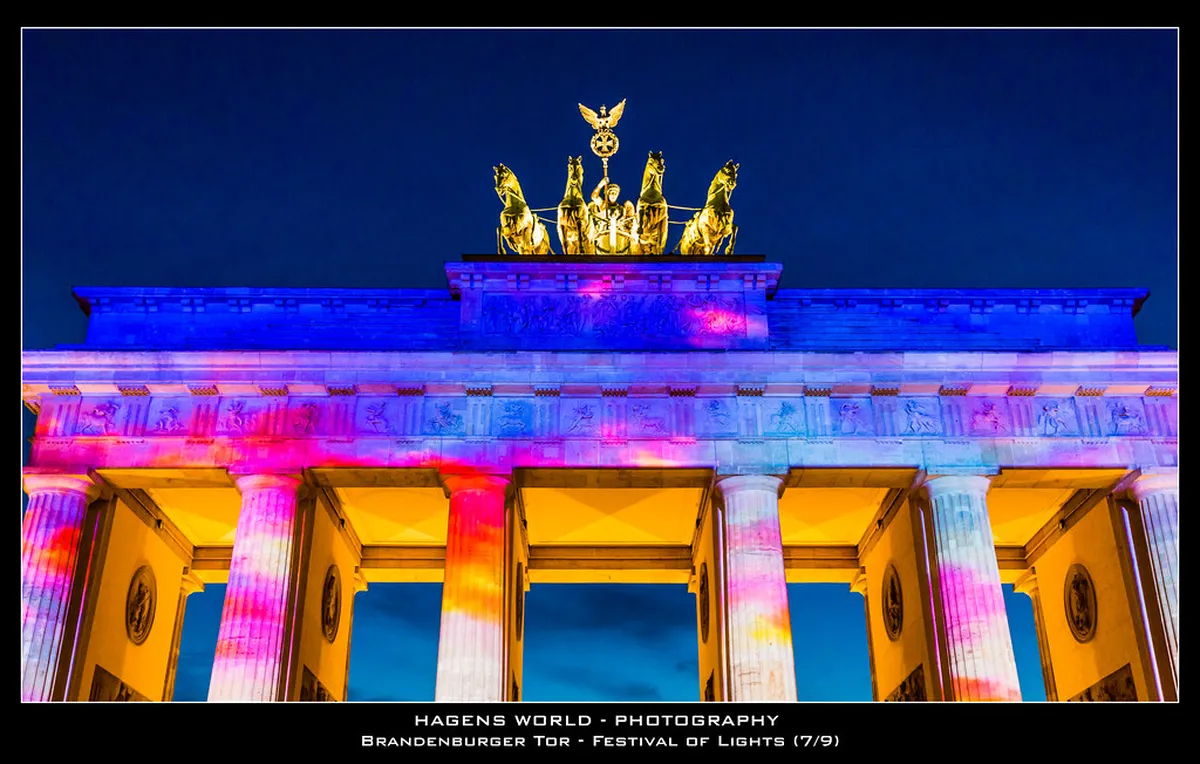
The Brandenburg Gate is the last surviving town gate of the eighteen entrances that once stood along Berlin's old customs wall, the Akzisemauer. King Frederick William II of Prussia commissioned architect Carl Gotthard Langhans to reconstruct it in 1788. Langhans modeled the new structure directly on the Propylaea gateway of the Acropolis in Athens, giving the city a monument that felt culturally rooted in ancient democracy. Construction was completed in 1791 using local sandstone, and Berlin soon earned the nickname "Spreeathen" — Athens of the Spree River.
The gate was originally known as the Peace Gate, or Friedenstor. Its five portals were not equal: the wide central passage was reserved exclusively for royalty and senior state figures, while ordinary citizens passed through the narrower outer arches. Two smaller flanking buildings — Haus Libermann and Haus Sommer — completed the ensemble. Both were destroyed in World War II, and faithful reconstructions stand in their place today.
The Quadriga statue, added to the top in 1793, depicted Eirene, the Greek goddess of peace, riding a four-horse chariot. The original orientation faced inward toward the Prussian palace at the end of Unter den Linden. That directional choice would later carry political consequences when Napoleon arrived.
Napoleon's Theft and the Prussian Reclamation
Napoleon Bonaparte marched his troops through the Brandenburg Gate on October 27, 1806, entering Berlin without a shot fired after routing Prussian forces at the twin battles of Jena and Auerstedt. He then claimed the Quadriga as a spoil of war, had it dismantled, and shipped it to Paris. The act was a calculated humiliation: taking the very goddess of peace from the Prussians' proudest monument. Detailed records of this era are available through the HISTORY Vault archives.
When Prussian troops defeated Napoleon in 1814 and reclaimed the statue, they did not simply restore it to its original form. Sculptor Karl Friedrich Schinkel redesigned the goddess's laurel wreath, replacing it with an Iron Cross topped by a Prussian eagle. The chariot was also rotated to face outward — away from Berlin and toward the neighboring states — as a deliberate message of military power to potential rivals. The peaceful Eirene had become the goddess of Prussian victory.
Following the statue's return, the gate became a site of triumphal ceremony. Prussian princes paraded their brides through the central arch, and military processions entered the city here after each subsequent victory. This transformation from peace gate to victory monument is one of the most significant symbolic shifts in European architectural history.
The Gate as a Symbol of the Third Reich
On the night of January 30, 1933, SS troops marched through the Brandenburg Gate by torchlight to celebrate Adolf Hitler's appointment as Reich Chancellor. The Nazi party then moved quickly to co-opt the monument as a symbol of their regime. The gate appeared on German banknotes with the Quadriga replaced by a swastika, and five enormous Nazi flags were hung from each side of the structure.
Hitler's planners also designated the gate as the eastern terminus of a grand "East-West Axis" boulevard through the city. Construction began in 1939 with Charlottenburger Chaussee — a seven-kilometre stretch linking the gate to what is now Theodor-Heuss-Platz. The plans required removing the gate's two flanking porticos to allow traffic flow. World War II ended before those alterations could be completed.
Allied artillery fire struck the gate repeatedly in the final days of the war. Most of the surrounding buildings in Pariser Platz were reduced to rubble. Yet the sandstone structure itself remained standing, and the Quadriga survived atop the pillars. When Nazi forces surrendered, Soviet soldiers planted the red hammer-and-sickle flag on the chariot — the latest regime to claim the gate as its own symbol.
Cold War Division: Standing in the Death Strip
Post-war Berlin was divided between the four Allied powers, and the Brandenburg Gate fell inside the Soviet sector. In June 1953, around 300 East Berlin construction workers went on strike at the gate to protest a 10% increase in work quotas. The protest grew quickly: within hours, half a million citizens had marched on Pariser Platz, tearing down Soviet flags and replacing them with black, red, and gold German ones. Soviet tanks crushed the uprising — fifty people died and thousands were arrested. The nearby boulevard was renamed Strasse des 17. Juni to commemorate those events.
The overnight construction of the Berlin Wall in August 1961 encased the gate inside the no-man's land known as the Death Strip. Neither East nor West Berliners could approach it. The gate was sealed, floodlit at night, and patrolled continuously. It became the world's most photographed symbol of ideological division, visible from observation platforms built on the western side.
In June 1963, President John F. Kennedy stood near the gate and delivered his "Ich bin ein Berliner" speech before an enormous crowd. In June 1987, President Ronald Reagan stood on the western platform and addressed Soviet leader Mikhail Gorbachev directly: "Mr. Gorbachev, tear down this wall." The gate served as a physical backdrop for both speeches, amplifying their message to a global audience. Two years after Reagan's visit, the wall fell.
December 1989: Celebrating the Fall of the Wall
On November 9, 1989, East Germany opened its borders and Berliners began dismantling the Wall. The Brandenburg Gate itself was not immediately accessible — its position in the Death Strip meant the area needed to be cleared before crowds could safely gather. The official reopening ceremony took place on December 22, 1989, when the Chancellor of West Berlin and the Prime Minister of East Berlin walked through the gate together. The moment was broadcast to hundreds of millions of people worldwide.
On Christmas Day 1989, conductor Leonard Bernstein led a performance of Beethoven's Ninth Symphony at the gate. In a deliberate act of cultural marking, he changed the word "Freude" (joy) in the "Ode to Joy" to "Freiheit" (freedom) — renaming it the "Ode to Freedom." The orchestra included musicians from both East and West Germany, the United States, the Soviet Union, France, and the United Kingdom. No single event captured the spirit of reunification more precisely.
German reunification was officially celebrated at the gate on October 3, 1990. Since then, it has hosted the city's New Year's Eve party each December 31, drawing up to a million visitors annually. The Brandenburg Gate now anchors one of the largest outdoor celebrations in Europe.
Architectural Highlights: The Quadriga and Greek Design
The gate measures 26 metres tall, 65.5 metres wide, and 11 metres deep. Its twelve Doric columns — six on each face — form five passageways. The outer reliefs depict scenes from Greek mythology, chosen deliberately to invoke the cultural prestige of ancient Athens rather than the military themes common in Baroque architecture of the period. The decorative frieze below the Quadriga carries the inscription "Zug der Friedensgottin" — procession of the goddess of peace — a phrase that became ironic after Napoleon's modifications.
The Quadriga itself stands 6 metres tall and was designed by sculptor Johann Gottfried Schadow. The original copper work was hammered by hand rather than cast, giving the surface its distinctive textured quality. After World War II damage destroyed most of the statue, East Germany produced a replica in 1958 — but omitted the Iron Cross and Prussian eagle from the staff, for ideological reasons. West Berlin objected. The symbols were restored only in 1990, after reunification. Wikipedia's detailed article covers the restoration timeline and the symbolic disputes in depth.
A major restoration project running from 2000 to 2002 cost six million euros and used laser technology to clean decades of pollution from the sandstone. The gate was re-unveiled on October 3, 2002 — German Unity Day — in its current clean condition. The work also restored the Iron Cross to the Quadriga's staff definitively, closing a four-decade dispute over the monument's symbolism.
The Room of Silence: A Hidden Space Inside the Gate
Few visitors know that the Brandenburg Gate contains an interior room open to the public. The Raum der Stille — Room of Silence — is located on the ground floor of the northern wing, immediately accessible from Pariser Platz. It has no religious affiliation and no formal entrance procedure. You simply walk through the small door on the north side of the gate and step inside.
The room is modest: a single space with seating, designed purely for quiet contemplation. A small candle burns in one corner. There are no guided talks, no displays, and no admission charge. The Berlin Senate established it in 1994 as a non-denominational space where anyone — regardless of background — could pause and reflect. Given the gate's history as a site of war, division, and eventual peace, the gesture is apt.
In practice, the Room of Silence is almost always empty or near-empty, even when Pariser Platz outside is packed. It opens at 11:00 and closes at 18:00 daily, including weekends. Most visitors crowd the central passageways and Pariser Platz without ever noticing the door. If you want five minutes of genuine quiet at one of Europe's busiest monuments, this is where to find it.
Photography Guide: Best Angles and Times of Day
The gate faces east, which means morning light hits the Pariser Platz side — the face that most visitors photograph first. For clean shots without crowds, arrive before 07:30. The columned facade catches the low eastern sun well until about 09:00, after which direct light from behind pushes harsh shadows into the portals. Arriving early also gives you the central passageway to yourself for walk-through shots, which become impossible once the tourist groups start at around 09:30.
The Tiergarten side — facing west onto Platz des 18. Marz — is the better location for afternoon and golden-hour shooting. Stand roughly 80 to 100 metres back, level with the tree line, for a clean frame that includes the full gate height and the Quadriga without foreground obstruction. Golden hour in summer (June–August) falls between approximately 20:30 and 21:30, giving you warm backlit tones across the sandstone. In winter, golden hour arrives around 15:30, which is easier to plan around for a day visit.
Blue hour — the 20 to 30 minutes after sunset — is arguably the best time to photograph the gate at night. The monument is illuminated from below, and the deep blue of the sky provides contrast that pure-night shots lack. A tripod is not required but helps. From the Pariser Platz side at blue hour, the lit colonnade and the darker sky above the Quadriga create the most reproducible strong composition. Shooting from ground level at the foot of the columns emphasises scale without distortion.
Essential Visitor Tips: Timing and Accessibility
Entry to the Brandenburg Gate and Pariser Platz is free at all hours, every day of the year. There are no tickets, no queues to join, and no timed entry. The site is busiest between 10:00 and 17:00 on weekdays and throughout the day on weekends. New Year's Eve draws close to a million people to the surrounding area, when the gate is closed to pedestrian access and replaced by a controlled festival zone. For current opening times and events, check visitberlin.de, Berlin's official tourism site.
Pariser Platz is fully pedestrianized and flat, making it straightforward for wheelchair users and pushchairs. The five portals are all accessible at ground level. The Room of Silence in the northern wing has a single step at the door threshold. Public toilets are located near the S-Bahn station entrance on the south side of the square. Check the best time to visit Berlin for seasonal crowd and weather patterns across the city.
The Room of Silence (Raum der Stille) is a hidden non-denominational contemplation space inside the gate's northern wing. Entry is free and open 11:00–18:00 daily. Most visitors pass through without noticing it — a perfect escape from the crowded Pariser Platz.
The dedicated station is Brandenburger Tor, served by S-Bahn lines S1, S2, and S25, and by the U5 U-Bahn line. Journey time from Berlin Hauptbahnhof is six minutes by S-Bahn. Using a standard AB zone ticket covers all these lines. A Berlin Welcome Card includes unlimited AB zone travel and is worth buying if you plan to visit more than three or four sites in a day. You should also consider how many days in Berlin you need to see the full historic core comfortably.
New Year's Eve (December 31) draws up to a million visitors. The gate is closed to pedestrian passage that day; access is restricted to a controlled festival zone with security screening. Plan a different date if you want to walk through the portals themselves.
Nearby Must-See Attractions in Pariser Platz
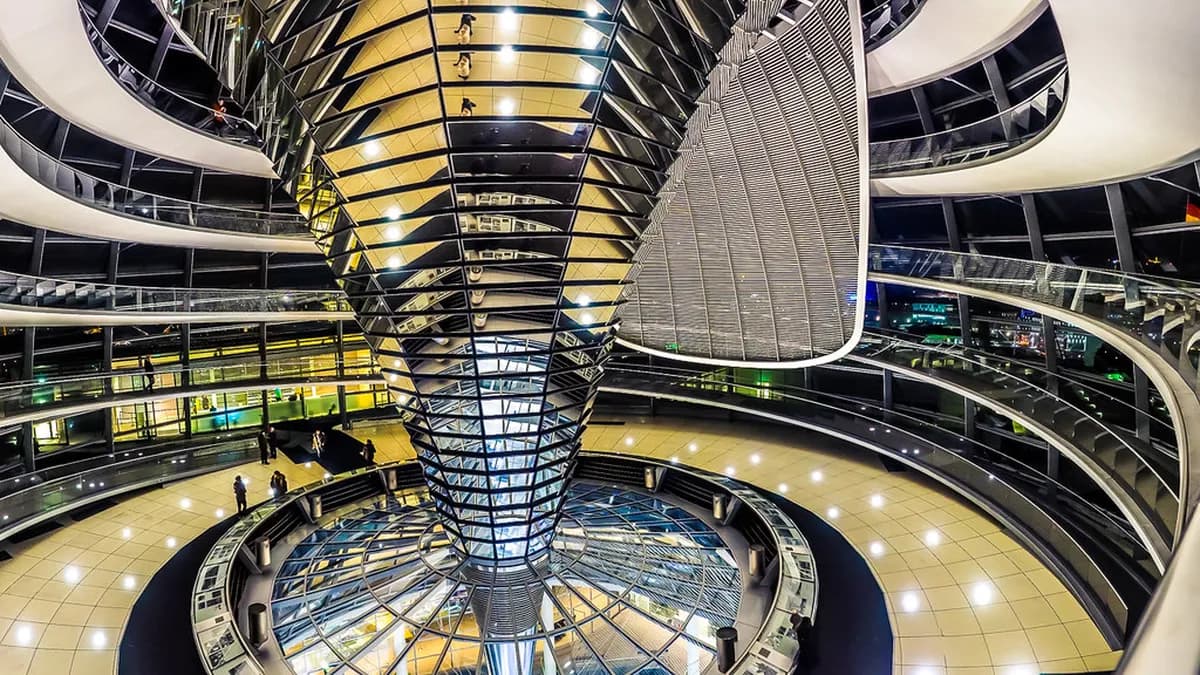
The Reichstag building is a six-minute walk north of the gate. Its glass dome, designed by Norman Foster, offers a 360-degree panorama over central Berlin and is free to enter — but must be booked online in advance through the Bundestag website. Booking slots fill weeks ahead during peak summer season, so reserve your place before you travel.
The Memorial to the Murdered Jews of Europe begins roughly 200 metres south of the gate. Its 2,711 concrete stelae of varying heights cover an entire city block. The underground information center beneath the memorial provides context on individual victims and the scale of the Holocaust. Entry to the memorial grounds is free and open around the clock; the information center charges no admission and opens Tuesday to Sunday from 10:00 to 20:00.
Unter den Linden stretches east from the gate for about 1.5 kilometres and passes the Humboldt Forum, Berlin Cathedral, and Museum Island. Walking the full length takes around 20 minutes at a comfortable pace. The Checkpoint Charlie site is a further 15-minute walk south through the former West Berlin side. The Tiergarten park immediately west of the gate provides shade and quiet after time in the open square — a useful midday escape in summer when temperatures on Pariser Platz can feel significantly hotter than the surrounding streets.
See our guide to the best things to do in Berlin for the full picture.
For related Berlin guides, see our 10 Essential Facts and Visitor Tips for Checkpoint Charlie and East Side Gallery Travel Guide.
Frequently Asked Questions
Is the Brandenburg Gate free to visit?
Yes, the Brandenburg Gate is completely free to visit. It is a public monument located in an open square called Pariser Platz. You can walk through the gate and take photos at any time of the day or night without a ticket.
Can you walk through the Brandenburg Gate?
You can walk through any of the five portals of the Brandenburg Gate today. While it was once restricted to royalty, it is now a fully pedestrianized area. This change happened after the 2002 restoration to celebrate its role as a symbol of unity.
What is the best time to visit the Brandenburg Gate?
The best time to visit is early in the morning before 9 AM to avoid crowds. Sunset and the blue hour also provide stunning lighting for photography. The gate is beautifully illuminated at night, making it a great stop for evening walks through Berlin.
Why is the Brandenburg Gate so famous?
The gate is famous because it has witnessed the most significant events in German history. It survived the Napoleonic wars, the Third Reich, and the Cold War division. Today, it is the ultimate symbol of German reunification and the end of the Iron Curtain.
How do I get to the Brandenburg Gate by public transport?
You should take the S-Bahn or U-Bahn to the 'Brandenburger Tor' station. Lines S1, S2, and S25 all stop here, along with the U5 subway line. Using a Berlin Welcome Card makes navigating the city's transport system very easy and affordable.
The Brandenburg Gate remains the most iconic landmark in the city of Berlin. Its history of division and eventual unity offers a powerful lesson for all visitors. You will find that standing beneath its massive columns is a truly memorable experience. Make sure to include this historic site on your next trip to Germany in 2026.
You might also like

Continue reading
More guides you'll find useful