Reichstag Building: History, Architecture, and Visiting Guide
Plan your visit to the Reichstag Building in Berlin. Explore its history, the iconic glass dome, and get practical advice on booking free tickets for the Bundestag.
On this page
Reichstag Building
The Reichstag building stands as one of the most visited parliament buildings in the world — and uniquely, it is free to enter. Visitors climb above the heads of their elected representatives inside a glass dome that has become a Berlin landmark in its own right. Understanding the building's layered history and the specific registration process is essential before you arrive. This guide covers everything from the 1894 foundation to the 2026 booking steps.
As the seat of the German Bundestag, the building bridges 19th-century Neo-Renaissance grandeur and cutting-edge sustainable design. It is one of the best things to do in Berlin for travelers who want context alongside sightseeing. The site rewards anyone who books in advance and arrives curious about the stories embedded in its stone, glass, and preserved graffiti.
A Turbulent History: From Imperial Germany to Reunification
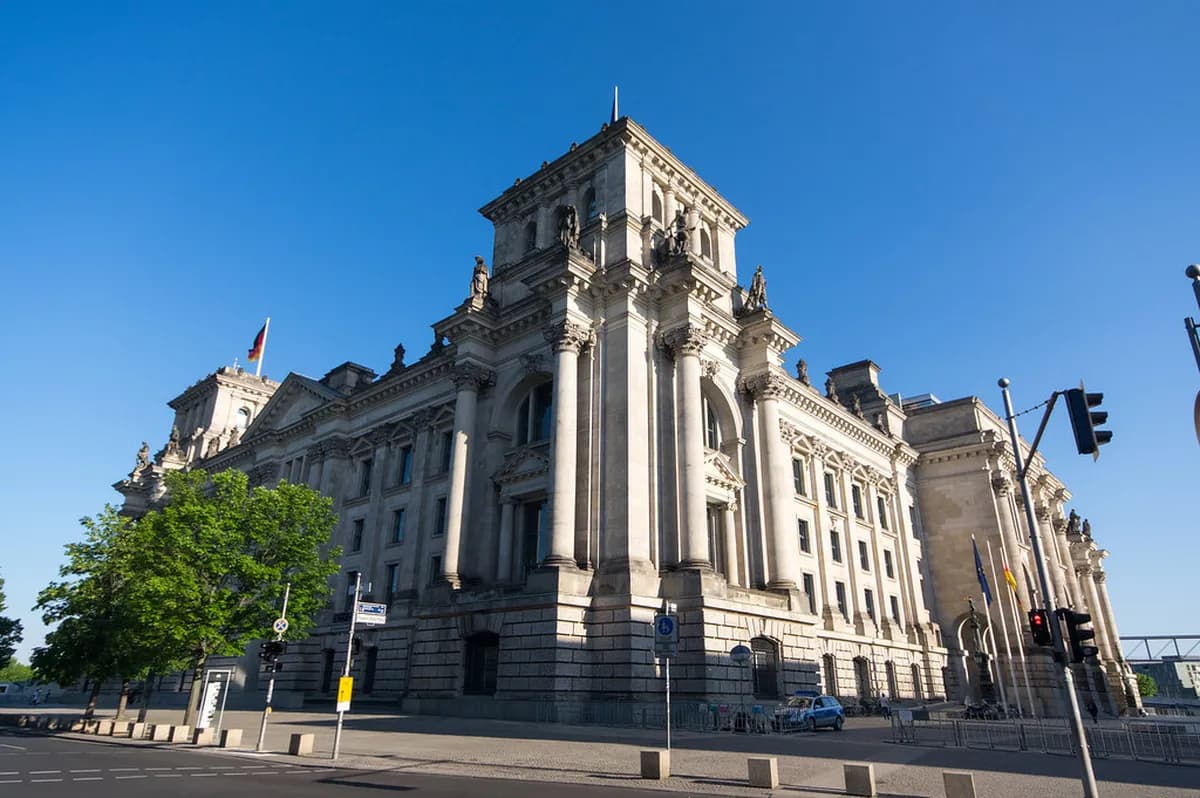
The Reichstag's foundation stone was laid in 1884 under architect Paul Wallot, who designed the building in a Neo-Renaissance style for the parliament of the newly unified German Empire. Construction took ten years, and the building officially opened in 1894. Decorative sculptures and mosaics were contributed by the artist Otto Lessing, giving the facade a richness that matched the ambitions of the era. Even so, Kaiser Wilhelm II famously dismissed it as "the pinnacle of bad taste."
The dedication inscribed on the facade — Dem Deutschen Volke, meaning "to the German People" — was not added until 1916, during the First World War. The inscription had been proposed from the beginning but blocked by the Kaiser for decades because he objected to the democratic sentiment it implied. Its eventual addition, over imperial objection, made the building's identity inseparable from the idea of popular sovereignty. That tension between authority and democracy has defined the building ever since.
The most catastrophic chapter came in 1933, when a fire gutted the interior and gave the Nazi party a pretext to suspend civil liberties across Germany. The building fell into neglect under the dictatorship and was severely damaged again during World War II. In May 1945, Soviet Red Army soldiers stormed the building and left extensive Cyrillic graffiti on the interior walls — messages that were preserved, under a protective transparent coating, during the 1990s restoration. Visitors on specific guided tours can still read them today.
After the war, West Germany's parliament moved to Bonn, and the Reichstag stood as a damaged shell beside the Berlin Wall for decades. Following German reunification in 1990 — which was officially proclaimed here — the decision was made to return the capital and parliament to Berlin. British architect Norman Foster was selected to rebuild the interior, and the Bundestag has convened here since April 1999.
Architectural Marvel: The Norman Foster Glass Dome
The glass cupola that crowns the Reichstag was not part of Norman Foster's original renovation concept. It emerged from the design process as a symbol of transparency: the public ascends above the parliamentary chamber below, literally above their elected representatives. Two steel ramps spiral upward in a double helix, allowing visitors to walk to an open observation platform at the top. The dome has a diameter of 40 meters, stands 23.5 meters tall, and weighs 800 metric tons of steel clad in 3,000 square meters of glass.
At the center of the dome is what Foster + Partners calls the "light sculptor" — a funnel-shaped cone covered in 360 mirrors. During daylight hours, the cone reflects natural light from the horizon down through the dome's oculus and into the plenary chamber below, reducing the need for artificial lighting significantly. A computer-controlled sun shield tracks the sun's arc across the sky to block glare and prevent heat buildup. As night falls, the process reverses: the chamber's lights illuminate the cone from below, turning the cupola into a glowing beacon visible across the Government District.
Sustainability was central to the Foster team's brief from the Bundestag. The building burns refined vegetable oil in a cogenerator to produce electricity, achieving a 94 percent reduction in carbon dioxide emissions compared with conventional fossil fuel systems — the Foster + Partners figure, not an estimate. Surplus heat is stored as hot water in a natural salt-water aquifer deep below the building, then pumped back up to heat the Reichstag in winter or drive an absorption cooling plant in summer. The result is a parliament that produces more energy than it consumes, functioning as a mini power station for the wider government quarter.
How to Visit: Booking Tickets and Online Registration
Admission to the Reichstag building is free, but every visitor must register in advance. Security protocols require that the Bundestag holds the full name and date of birth of every person in a visiting group before they arrive. The Official Bundestag Registration Portal is the only place to book, and it accepts reservations up to two months ahead. In 2026, slots on weekends and public holidays fill within days of opening — booking two to four weeks in advance is the realistic minimum for most travelers.
Entry is completely free, but advance registration is mandatory — walk-ins are not permitted. Register on the official Bundestag portal (bundestag.de/en/visittheBundestag/dome/registration) and bring the exact identification documents (passport or EU national ID) you provided during booking.
If your travel dates are fixed and the advance window has passed, there is a last-minute option. The Bundestag visitor service center, located in a glass pavilion on the Scheidemannstrasse side of the building, releases unclaimed time slots on a rolling basis, typically up to 48 hours before the visit time. Queue early in the morning — demand is high in summer — and bring passports for every person in your group. There is no guarantee of availability, so treat this route as a backup rather than a plan.
Arrive at least 30 minutes before your registered slot to clear security. The process resembles airport screening: bags go through an X-ray machine, and all visitors pass through a body scanner. Prohibited items include large bags, tripods inside the building (though tripods are permitted on the roof terrace), and sharp objects. Bring a valid passport or EU national ID card that matches your registration exactly — a mismatch will result in denied entry.
There are three distinct ways to experience the Reichstag, all free of charge. The dome and roof terrace visit is self-guided with a free audio guide available in multiple languages; it takes 60 to 90 minutes. Guided tours of the building's interior — covering the plenary chamber, historic art installations, and the preserved Soviet graffiti layer — are also bookable through the portal and last approximately two hours. When the Bundestag is in session, you can also register to attend a plenary session from the public gallery, where simultaneous interpretation is available; these sessions are listed on the Bundestag website and should be booked separately. The Käfer Dachgarten restaurant on the roof requires its own separate reservation and has a dedicated security entrance.
The Soviet Graffiti: A Living Museum Inside the Walls
One of the most powerful and least-publicized features of the Reichstag is its preserved layer of Soviet graffiti from May 1945. When Red Army soldiers captured the building in the final days of World War II, they left thousands of Cyrillic inscriptions on the interior walls — names, hometowns, expressions of survival and victory. Foster + Partners made the deliberate decision to keep them as what the architects described as a "living museum," treating the marks as a historical layer equal in importance to the original stonework.
The graffiti are protected under a clear transparent coating so they will not fade or be damaged by air or touch. They are not displayed in a museum case or behind glass — they exist directly on the plaster and stonework, exactly where the soldiers wrote them. This is not something you see on the dome visit; you need to book a guided interior tour through the Bundestag portal to access the administrative levels where the graffiti are concentrated. The experience is striking: political speeches happen meters away from messages left by soldiers who had just fought across half a continent.
In 1995, four years before the restored building reopened, artist Christo and his wife Jeanne-Claude wrapped the entire Reichstag in 100,000 square meters of silvery fabric for two weeks. It drew five million visitors. The wrapping is now part of the building's modern mythology — and a reminder that the structure has always attracted acts of reinterpretation as much as reverence.
Exploring the Government District: What to See Nearby
The Reichstag anchors the Regierungsviertel, Berlin's Government District, where modern federal ministry buildings line the north bank of the Spree. The Federal Chancellery — the Kanzleramt, office of the German Chancellor — is a five-minute walk west along the river. Its white curved facade is sometimes called "the washing machine" by Berliners. The whole area is open to the public with wide pedestrian paths and riverside promenades that make for a pleasant 45-minute loop on foot.
Five minutes east of the Reichstag sits the Brandenburg Gate and Pariser Platz, the defining symbol of German reunification. From there, the Memorial to the Murdered Jews of Europe — 2,711 concrete slabs by architect Peter Eisenman — is a two-minute walk south. Two other nearby memorials deserve attention: a circular pool in the Tiergarten commemorates the Sinti and Roma victims of National Socialism, and a concrete cube on Ebertstrasse shows a video memorializing homosexuals persecuted under the Nazi regime. Seeing all four sites together gives a coherent picture of how Berlin has chosen to reckon with the 20th century.
The Tiergarten park begins immediately west of the parliament and stretches for nearly four kilometers. It is ideal for a slow walk between sites, particularly in spring and early summer when the linden trees are in bloom. Many travelers who visit the free things to do in Berlin page discover that the Reichstag-to-Brandenburger Tor-to-Tiergarten corridor makes a self-contained morning with no entry fees at all.
Practical Tips: Getting There and Accessibility
The most direct public transport option is the U5 line to Bundestag station, which exits directly in front of the building's west entrance on Scheidemannstrasse. The S-Bahn lines S3, S5, S7, and S9 stop at Berlin Hauptbahnhof, which is a ten-to-fifteen-minute walk east along the river. Tram M5, M8, and M10 lines connect from Mitte and Prenzlauer Berg to Hauptbahnhof if you are arriving from the east side of the city. Bus lines 100 and 200 stop directly at the Reichstag/Bundestag stop on Scheidemannstrasse.
Weekend and holiday slots sell out rapidly — often within 24 to 48 hours of the two-month advance window opening. If your travel dates are fixed and you miss the advance booking window, your only recourse is arriving early at the visitor center on Scheidemannstrasse to queue for last-minute cancellations (no guarantee). Book as far ahead as possible.
The building is fully accessible for visitors with limited mobility. Ramps and elevators reach the roof terrace and the spiraling dome walkway. Special tours for guests with visual or hearing impairments are available on request through the Bundestag portal — book these specifically, as standard guided tours are not adapted. The roof terrace is flat and wide, suitable for wheelchair users, and the audio guide for the dome is available in a text format on loan.
For photography, the best window is the Blue Hour — roughly 21:00 to 21:30 in June — when the dome is illuminated from within and the sky holds a deep blue rather than full black. Tripods are permitted on the roof terrace but not inside the dome's ramp area. The west-facing terrace catches the last light of sunset over the Tiergarten. Plan at least 90 minutes for the dome visit, and if you are combining it with the Brandenburg Gate and the Holocaust Memorial, allow a full three-to-four-hour morning or evening block. Midweek slots are considerably quieter than weekend visits, particularly on Tuesdays and Wednesdays when the Bundestag is typically in full session and many tourists avoid the area.
See our guide to the best things to do in Berlin for the full picture.
For related Berlin guides, see our 10 Essential Facts and Visitor Tips for the Brandenburg Gate and 10 Essential Facts and Visitor Tips for Checkpoint Charlie.
Frequently Asked Questions
Is it free to visit the Reichstag building?
Yes, visiting the Reichstag building and its famous glass dome is completely free of charge for all guests. However, you must register in advance to gain entry. Using the Berlin Welcome Card can help you save on other paid attractions nearby.
Can you visit the Reichstag without a reservation?
Spontaneous visits are difficult because security requires pre-registered data for all guests. You can try to book last-minute at the visitor center across the street if slots remain. It is always better to secure your spot online at least two weeks before your arrival date.
How much time should you plan for a Reichstag visit?
Most visitors spend about 60 to 90 minutes exploring the roof terrace and the glass dome. This timeframe allows you to listen to the full audio guide while enjoying the panoramic views. If you attend a plenary session or a guided tour, plan for at least two to three hours.
What is the history of the Reichstag fire?
The Reichstag fire occurred in February 1933 and severely damaged the building's interior. The event was used by the Nazi party to suspend civil liberties and consolidate their political power. It remains one of the most significant and controversial events in modern German history.
Are there restaurants inside the Reichstag?
The Käfer Rooftop Restaurant is located right next to the glass dome on the roof of the building. It is the only public restaurant in a parliament building anywhere in the world. You must book a table in advance to pass through the specific security entrance for diners.
The Reichstag building is much more than a place where politicians meet to vote on legislation. It is a layered document — stone, glass, graffiti, and inscription — that records over 130 years of German history in a single structure. Walking the dome gives you a panorama of the capital and a literal view down into the chamber of democracy. No visit to Berlin is complete without it.
Book your registration at least two to three weeks out, bring valid ID, and plan to arrive early enough to clear security without stress. Whether you are fitting this into a one day in Berlin itinerary or taking your time across several days, the combination of the dome, the Government District walk, and the Brandenburg Gate makes for one of the most content-rich free mornings in any European city.
You might also like

Continue reading
More guides you'll find useful