15 Best Free Things to Do in Berlin: Budget Travel Guide (2026)
Discover the best free things to do in Berlin, from the East Side Gallery to hidden gardens. Plan your budget trip with local tips and must-see memorials.
On this page
15 Best Free Things to Do in Berlin
After three visits to Berlin over the last five years, I have discovered that the city's best experiences rarely come with a price tag. The German capital is unique because its most profound history is written directly onto its streets and public squares. Whether you are exploring the scars of the Cold War or relaxing in a repurposed airfield, you can see the best of the city without spending a single Euro.
This guide covers the top free attractions for travelers visiting in 2026. I have vetted these locations to confirm they remain accessible and free of charge. Before you pack your bags, check the Best Time to Visit Berlin: Seasonal & Monthly Guide to align your trip with the best weather for walking.
Berlin Wall Walk and Memorial
The Berlin Wall Memorial at Bernauer Straße is the most complete open-air site for understanding the Wall's human cost. It stretches along 1.4 km of the former border strip, preserving original guard towers, the death strip, and escape tunnels. Entry to the outdoor grounds is free and the site is open daily from 8:00 to 22:00.
Start at the visitor center on Bernauer Straße to watch the short documentary before walking the grounds. The documentary runs continuously and gives essential context for the outdoor exhibits, which cover the stories of those who attempted to cross the border. The memorial chapel, built on the footprint of a demolished church, is one of the most quietly moving spots in the city.
The Bernauer Straße site often sees morning crowds taper off by late afternoon. Arrive after 16:00 if you prefer quieter exploration, or book the first entry slot at 08:00 opening for a meditative solo walk.
The free indoor documentation center (Tuesday to Sunday, 10:00 to 18:00) holds photographs, original artifacts, and testimonies from survivors and border guards alike. Combined with the outdoor walk, budget at least two hours here. You can find more context and photos in our Berlin Wall visitor guide.
The East Side Gallery
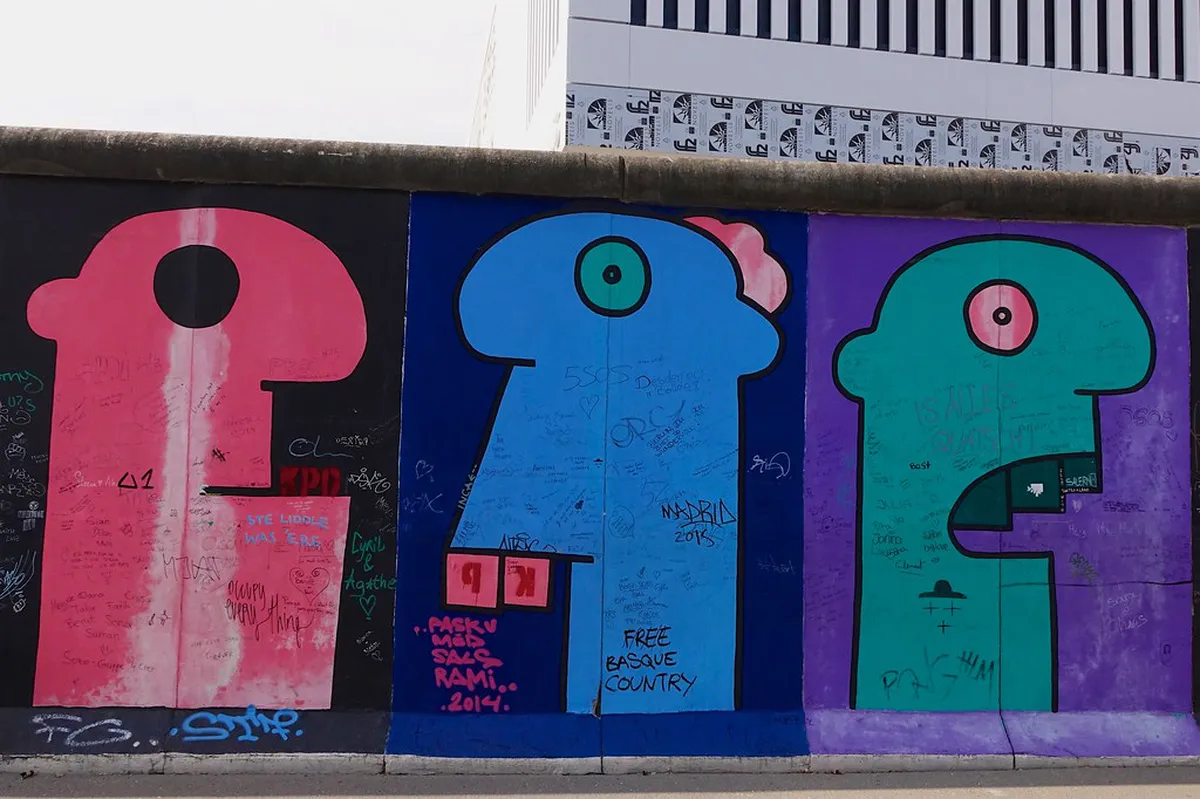
The East Side Gallery is the world's longest open-air art gallery and the most immediately recognizable stretch of the original Wall. Between Oberbaumbrücke and Schillingbrücke along the Spree, 105 artists from 21 countries painted murals here in 1990 to celebrate reunification. The gallery is a public sidewalk, so access is free 24 hours a day.
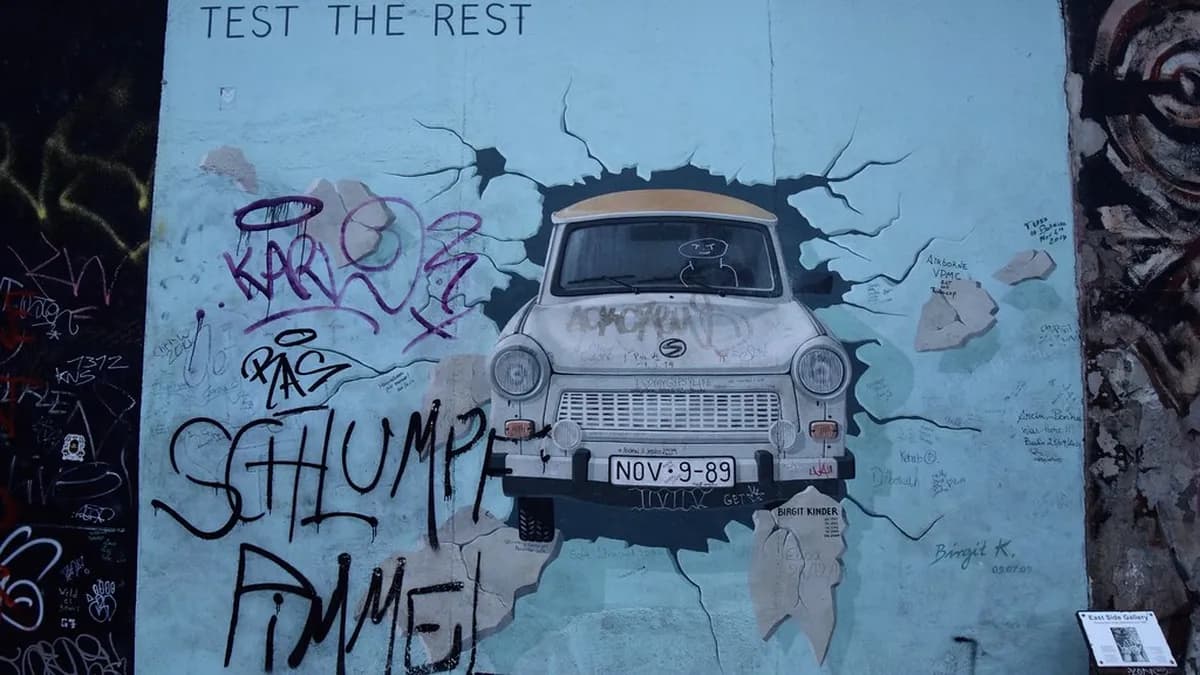
Dmitri Vrubel's 'Fraternal Kiss' — showing Soviet and East German leaders embracing — is the most photographed mural. Birgit Kinder's painting of a Trabant smashing through the wall is another crowd favorite. Both attract significant foot traffic from mid-morning onward, so arrive before 09:00 if you want an unobstructed photo.
The gallery runs for just over a kilometer, which takes about 30 to 45 minutes to walk end to end. Several cafes and bars on the Spree side offer outdoor seating where you can sit with a coffee and look back at the murals. This area is a highlight of any comprehensive Berlin itinerary.
Checkpoint Charlie
Checkpoint Charlie was the most famous crossing point between East and West Berlin during the Cold War. It is now a heavily visited outdoor site in Mitte, easily reached via the U6 to Kochstraße. Standing at the replica guardhouse costs nothing, and the surrounding outdoor exhibition boards tell the checkpoint's history clearly and for free.
Be aware that the area has become quite commercial. Actors dressed as soldiers charge for photos, and vendors sell fake Wall fragments — both are tourist traps worth skipping. The replica guardhouse and the large replica sign are exactly that: replicas. The original guardhouse is displayed at the Allied Museum in Dahlem.
The free outdoor display panels along the surrounding streets explain the 1961 tank standoff between US and Soviet forces, the escape attempts, and the eventual fall of the Wall. That information is substantive enough on its own. If you want the full story of escape vehicles and disguises, the Mauermuseum next door charges entry — save that for a day when your budget allows.
The Holocaust Memorial
The Memorial to the Murdered Jews of Europe covers an entire city block just south of the Brandenburg Gate. Designed by architect Peter Eisenman, its 2,711 grey concrete slabs of varying heights create a disorienting, labyrinthine space that conveys isolation and unease. The outdoor memorial is free and open 24 hours a day.
Walking into the center of the field, the sounds of the city fade and you are surrounded by concrete on all sides. The ground slopes unevenly underfoot, which adds to the deliberate sense of instability. Many visitors find the experience unexpectedly affecting, even on a bright afternoon.
The underground information center, also free, opens Tuesday to Sunday from 10:00 to 19:00 (last entry 18:15). It contains individual stories, photographs, and documented testimonies from across Europe. Please do not climb on the stones — security staff monitor the site and will ask you to descend.
Topography of Terror
The Topography of Terror sits on the site of the former Gestapo and SS headquarters in central Berlin, near Potsdamer Platz. Both the indoor permanent exhibition and the outdoor trench along the original Wall are free. The site is open daily from 10:00 to 20:00.
The outdoor section is the most visceral part of the visit. You walk along the excavated basement ruins of the Gestapo cells, with information panels detailing how the Nazi security apparatus was organized and how it operated across Europe. The exposed brickwork and rubble sit directly below street level, making the history feel immediate rather than curated.
The indoor exhibition runs to over 800 square meters and covers the rise of the SS, the persecution of political opponents, and the final days of the regime in Berlin. It is dense with primary sources, including original documents, photographs, and film. Budget 90 minutes minimum for both sections. This is one of the most visited free sites in the city precisely because the curation is so thorough.
Tränenpalast: The Palace of Tears
The Tränenpalast — which translates as Palace of Tears — is one of the most emotionally raw free sites in Berlin and one that most visitors walk past without knowing it exists. It occupies the former border hall of Friedrichstraße station, the only S-Bahn stop where East Berliners could briefly meet Western relatives before saying goodbye and returning to the GDR side. The name came from the scenes of farewell that played out here daily for almost three decades.
Today it is a free permanent exhibition run by the German Historical Museum, open Tuesday to Friday from 9:00 to 19:00 and weekends from 10:00 to 18:00. The original hall has been preserved with its institutional green tiles and low ceilings. Photographs, audio recordings, and original artifacts — including the turnstiles and the booths where border guards reviewed papers — remain in place.
What sets this apart from the more famous Wall memorials is its human scale. Individual stories of couples separated for years, of children who grew up without parents on the other side, are documented in personal letters and recorded interviews. It takes about 45 minutes to move through the exhibition. The station is on the S1, S2, S3, S5, S7, S9, and U6 lines, making it effortless to combine with a Reichstag visit or a walk along Unter den Linden.
Brandenburg Gate and Unter den Linden
The Brandenburg Gate is Germany's most recognizable landmark and the symbol of national reunification. Built in 1791 as a neoclassical city gate, it was stranded in no-man's-land during the Wall years and became the focal point for the celebrations on 9 November 1989. Viewing the gate from Pariser Platz is free at any hour.
The 'Room of Silence' in the gate's northern wing is worth stepping into. It is a small, unadorned space set aside for quiet reflection — easy to miss but genuinely calming in the middle of a busy plaza. Entry is free and there is no time limit.
After the gate, walk east along Unter den Linden, Berlin's oldest boulevard. The route passes the Neue Wache memorial, the Zeughaus armory (now the German Historical Museum), the Humboldt Forum, and eventually Berlin Cathedral. All outdoor viewing along this stretch is free. The Neue Wache, a small neoclassical memorial hall with an eternal flame, is particularly worth pausing at — entry is free and it is rarely crowded.
Reichstag Building Dome and Rooftop
The glass dome of the Reichstag offers one of the best panoramic views of Berlin and entry is entirely free. You walk a spiral ramp to the top of the dome while a free audio guide identifies landmarks in every direction. The rooftop terrace adds a 360-degree open-air perspective over the Tiergarten, the Spree, and the city skyline.
The critical detail: you must register online at the official Bundestag portal well before your visit. Slots for popular times — particularly sunset, roughly 20:00 to 21:00 in summer — fill two to three weeks in advance. Book as soon as your travel dates are confirmed. Bring your passport; photo ID is mandatory at the security check and you will not be admitted without it.
The dome is open daily from 8:00 to midnight, with the last admission at 21:45. Guided tours of the parliamentary chamber itself are also free but require separate registration and even earlier booking. If you can only manage one free view of the city, prioritize the Reichstag over paid alternatives like the TV Tower, where adult tickets exceed €25.
Soviet War Memorial in Treptow
The Soviet War Memorial in Treptower Park is the largest Soviet memorial outside Russia and a genuinely stunning piece of Stalinist monumental architecture. Built in 1949 to honor the 7,000 Soviet soldiers buried here who died in the Battle of Berlin, the complex is free to enter and open 24 hours as part of the wider park.
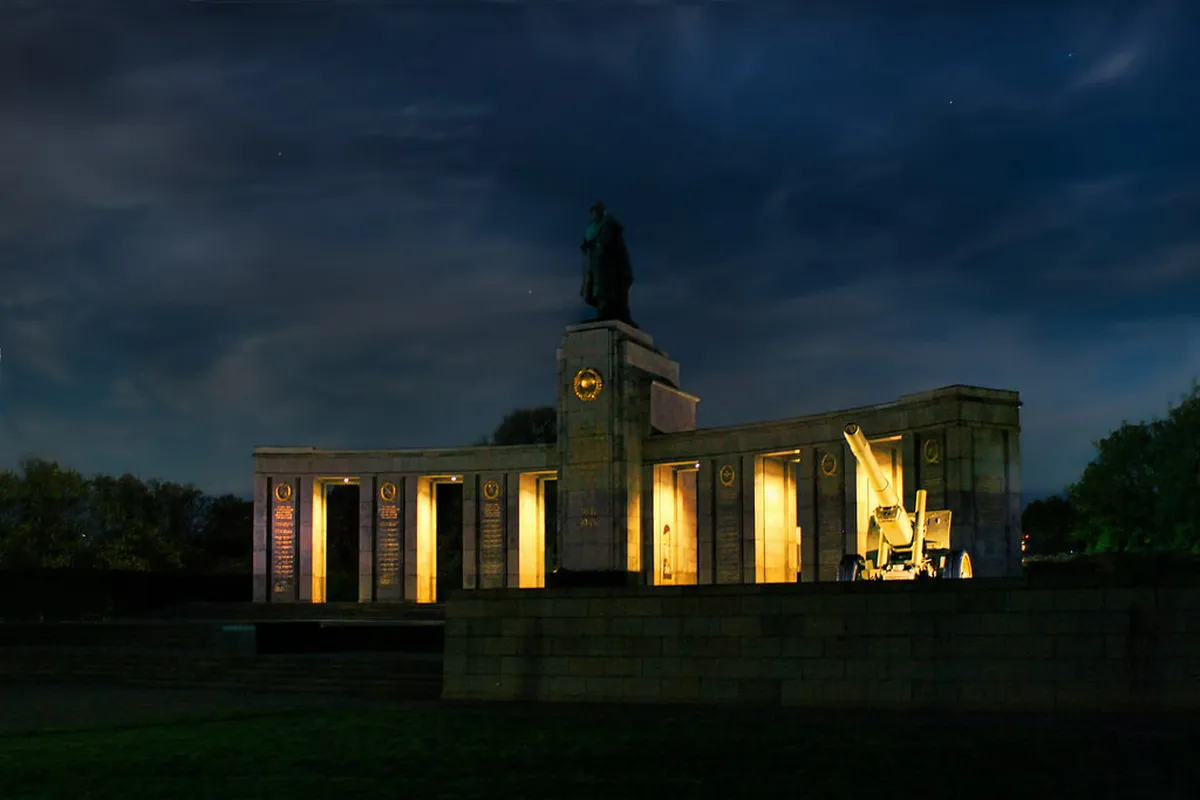
The scale is what stops visitors short. A 12-meter bronze soldier stands on a plinth at the far end of the complex, sword in hand, crushing a swastika underfoot and holding a rescued German child. Flanking the central lawn are 16 stone sarcophagi embellished with military scenes and quotes from Stalin. Two red granite portals shaped like Soviet flags mark the entrance.
The memorial is far less crowded than the Tiergarten Soviet memorial, which makes it easier to move through at your own pace. After visiting, walk along the Spree within the park to reach the Insel der Jugend — a small island with a riverside bar — and the Abbey Bridge, Germany's first composite steel bridge. The park is reached via S-Bahn to Treptower Park station (S8, S9, S85).
Gardens of the World in Marzahn
The Gardens of the World in the Marzahn district features traditional garden designs from China, Japan, Bali, Korea, Italy, and several other cultures spread across a large landscaped park. The main park does charge a small entry fee (around €8 for adults in 2026), but the surrounding Kienberg Park — including the hilltop viewing platform over the city — is free to access at any time.
A local tip: the cable car over the park costs extra, but you can walk the same route on foot for free and often get better angles for photography without glass reflections. The path to the hilltop takes about 20 minutes and offers wide views over Marzahn and the eastern city. Bring binoculars on a clear day for Berlin's western skyline.
The gardens are reached via U5 to Kienberg/Gärten der Welt station, which opened with the 2017 IGA horticultural show and is now a permanent stop. Check the official site for occasional free garden days that coincide with local festivals. The park is open daily from 09:00 until sunset and is at its best in May and June when the Chinese garden's wisteria is in bloom.
Urban Nation Museum for Urban Contemporary Art
Urban Nation is one of the world's only museums dedicated entirely to street art and urban contemporary art, and entry is completely free. Located in Schöneberg, the museum is open Tuesday to Sunday from 10:00 to 18:00. The building's exterior — a three-story rotating mural installation — is itself one of the most photographed facades in Berlin.
Inside, the permanent collection includes large-scale works by internationally recognized artists including Os Gemeos, Shepard Fairey, and Vhils. The gallery space is genuinely high quality — this is not a makeshift pop-up but a professionally curated institution with lighting rigs and conservation standards comparable to a state museum.
Temporary exhibitions rotate roughly every three to four months. In 2026, the museum is continuing its programming around social commentary and identity in urban spaces. Take the U-Bahn to Bülowstraße on the U1 and U3 lines — the walk from the station to the museum passes through streets covered in commissioned murals, effectively extending the visit before you even step inside.
Open Study Room at the Humboldt Forum
The Open Study Room inside the reconstructed Berlin Palace (Humboldt Forum) is a unique free space dedicated to critical engagement with colonial history and racism. It is not a traditional museum gallery but a research and learning room: visitors can access primary sources, books, and digital archives on topics including the provenance of ethnological collections and Berlin's colonial past.
The room is open Tuesday to Sunday from 10:00 to 20:00. It appeals most to visitors who want to engage with Berlin's complex identity beyond the Cold War narrative — academics, students, and curious travelers willing to sit with difficult material. The Humboldt Forum's central courtyards are also freely accessible, and the building's architecture — a Baroque facade housing an entirely contemporary interior — is worth spending time with on its own.
Note that while the Open Study Room is free, some of the Humboldt Forum's gallery floors charge entry. Check before visiting which floors are included in the free tier, as the configuration changes with temporary exhibitions.
Tempelhofer Feld
Tempelhofer Feld is a former international airport that closed in 2008 and was converted into Berlin's largest public park. Its old runways — still marked with faded taxiway signs — are now used by cyclists, inline skaters, kite surfers, and anyone who wants vast, flat space in the middle of a major city. Entry is free from sunrise to sunset every day of the year.
The scale is the point. At 386 hectares, Tempelhofer Feld is larger than Central Park in New York and offers an openness that is rare in any urban environment. The terminal building, designed by Ernst Sagebiel in the 1930s, runs along the north side of the field and can be viewed from the outside for free — its colonnaded facade is one of the most architecturally distinctive in Berlin.
Rent a bike at Mitte for €10–15/day and explore the outer loops of Tempelhofer Feld; the main runway is best for walkers and runners. Bring sunscreen and water — there is minimal shade and summer temperatures can exceed 28°C (82°F).
Community gardens line the outer edge of the field and are tended by residents. In summer, the grassy areas fill with picnickers, barbecues, and informal football games. Go at sunset for a view of the western sky unobstructed by buildings. The park is reached via U6 to Platz der Luftbrücke.
Free Walking Tours of Mitte
Several operators run tip-based walking tours of central Berlin that are technically free to join. The tours typically cover Checkpoint Charlie, the Holocaust Memorial, Brandenburg Gate, and Bebelplatz — the site of the 1933 book burning — in a three-hour loop. Most depart from the Brandenburg Gate or Alexanderplatz multiple times daily.
A tip of €10 to €15 per person is customary and expected. Think of the price as what you would pay for an entry ticket — guides work for tips and a good one brings the history to life in ways that reading plaques cannot. Generator Tours and Sandemans both have reliable operations; look for the guides holding branded umbrellas at the meeting points.
For a more neighborhood-focused experience, some operators also run tours of Kreuzberg and Friedrichshain, which cover the street art and alternative culture scene. These tend to be smaller groups and attract more repeat visitors who have already done the standard historical circuit. Book any tour online in advance — spots do fill during peak summer months.
Wild Bee Exhibition at the Wildlife Foundation
The Wild Bee Exhibition at the Deutsche Wildtier Stiftung (German Wildlife Foundation) is a niche educational stop that suits families with younger children. It covers native pollinator species, urban biodiversity, and the difference between honeybees and wild bees in a compact, approachable format. Entry is free and the exhibition is generally open weekdays from 10:00 to 16:00.
The foundation operates a small demonstration garden outside the exhibition space where visitors can see native wildflowers planted specifically to support urban pollinators. It is a calm, unhurried stop in contrast to the heavily visited memorials nearby. Staff provide free printed guides explaining how to support wild bee populations at home.
This is a genuinely low-key stop. Do not go expecting a large natural history museum. It works best as a 45-minute break between larger sites in the Tiergarten area, particularly with children who need an activity that does not involve another concrete memorial.
Other Free Things to Do in Berlin
Mauerpark in Prenzlauer Berg hosts one of Berlin's most popular flea markets every Sunday from 07:00 to 17:00. Entry is free and you can browse everything from GDR memorabilia to vintage clothing to handmade art. The same park hosts Bearpit Karaoke on sunny Sundays from around 15:00 — an outdoor amphitheatre where strangers sing to an enthusiastic crowd. It is absurdly fun and costs nothing.
Thai Park in Preußenpark, Wilmersdorf, is another free-entry gathering. On sunny weekends from April to October, the park fills with Thai community members selling homemade food from blankets and picnic setups — an informal outdoor food market unlike anything else in the city. The food costs money, but strolling through the atmosphere is free and the variety of dishes is remarkable.
The Museum in der Kulturbrauerei in Prenzlauer Berg offers a free permanent exhibition on everyday life in East Germany (the GDR), including 800 original objects from the period. It is open Tuesday to Sunday and provides an accessible counterpoint to the heavier memorial sites. The Berliner Philharmoniker also runs free lunchtime concerts in the foyer on Tuesdays at 13:00 during the concert season — seats are limited, so arrive early.
Planning Your Free Berlin Itinerary
Organize your days by neighborhood to cut travel time. Mitte covers the Brandenburg Gate, Holocaust Memorial, Topography of Terror, Checkpoint Charlie, and Tränenpalast within roughly 30 minutes of walking. Add the Reichstag and you have a full day without leaving the central zone. Book the Reichstag dome before anything else — the registration portal fills fastest for sunset slots. For a curated guide to lesser-known sights, check Visit Berlin, the official tourism portal.
Many state museums offer free entry on the first Sunday of every month. This 'Museum Sunday' covers major institutions on Museum Island and is extremely popular. Reserve your free time slots online the moment they open — they typically go within hours of release. For other days, check the Museum Pass Berlin to assess whether the paid tier fits your budget.
Always carry a small amount of cash. Berlin is becoming more card-friendly but many park kiosks and small stalls still operate on Bargeld only. Planning ahead with a 3-day Berlin itinerary will help you sequence the free sites efficiently and leave time for the city's paid highlights that do earn their entry price.
Frequently Asked Questions
Is the Reichstag dome free to visit in 2026?
Yes, the Reichstag dome and rooftop terrace remain free to visit. You must register in advance through the official parliament website. I recommend booking at least three weeks before your trip to secure a sunset time slot.
Are museums in Berlin free on certain days?
Many major museums participate in Museum Sunday, offering free entry on the first Sunday of each month. You still need to reserve a digital ticket online. Some smaller galleries and memorial sites are free every day of the week.
How many days do you need to see the main free sights in Berlin?
I recommend spending at least three to four days to cover the major free landmarks without rushing. This allows you to explore the central history in Mitte and the local parks in Neukölln or Friedrichshain. Check our itinerary guides for more detailed planning.
Berlin is a city that rewards those who explore on foot and keep an eye out for its hidden stories. By prioritizing these 15 free things to do, you can experience the depth of German culture without breaking the bank. The money you save on entrance fees can be better spent on a great meal or a night out in the city's famous clubs.
Remember to book your Reichstag tickets early and keep an eye on the local weather for your park days. Whether you are a history student or a casual traveler, Berlin's free attractions offer something for everyone. Safe travels, and enjoy discovering one of the most vibrant and affordable cities in the world.
You might also like


Continue reading
More guides you'll find useful