East Side Gallery Travel Guide
Plan your visit to the East Side Gallery with our guide to the best murals, historical context, transport tips, and local neighborhood picks.
On this page
East Side Gallery Travel Guide
The East Side Gallery stands as a monumental 1,316-meter stretch of the original Berlin Wall along the Spree River in Friedrichshain. Over one hundred murals from 118 artists across 21 countries cover the eastern face of the concrete, making it the longest open-air gallery in the world. This site remains one of the most iconic landmarks in Berlin for history lovers and art enthusiasts alike. It is free to enter, open around the clock, and requires no advance booking.
Walking along Mühlenstraße connects you directly to the Cold War history embedded in this concrete barrier. The murals capture the euphoria of November 1989 and the complicated hopes of the reunification years that followed. Understanding the stories behind these slabs — who painted them, why some were repainted and some were not — makes the visit far richer than a simple photo stop. Allow 60 to 90 minutes for the full 1.3-kilometer walk.
What is the East Side Gallery?
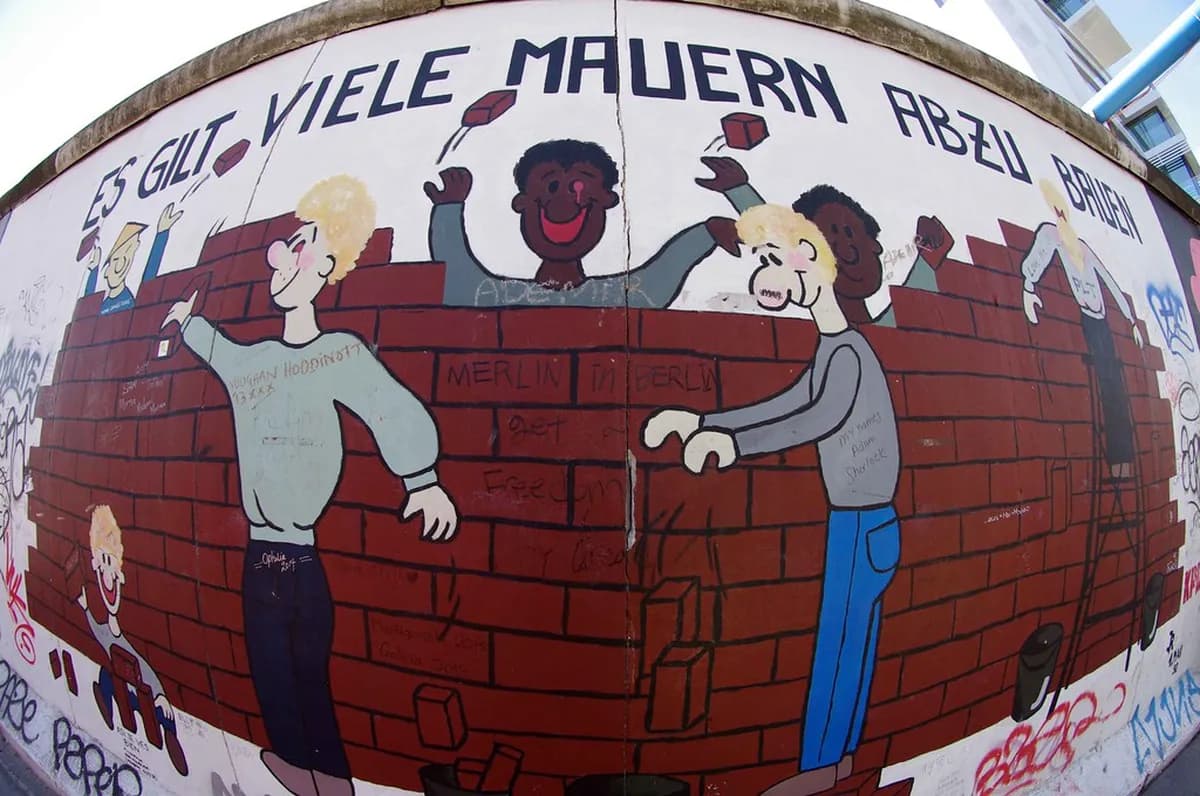
The East Side Gallery is a heritage-protected landmark consisting of 101 murals painted directly onto the eastern side of the Berlin Wall. Unlike most remaining wall segments, this portion served as the hinterland wall facing East Berlin — soldiers patrolled the strip between it and the Spree River to prevent escapes into the West. After the border opened in November 1989, artists from around the world gathered on Mühlenstraße to transform the gray concrete into a public record of the era.
The gallery stretches between Ostbahnhof railway station to the north and the historic Oberbaumbrücke bridge to the south. It was officially opened as a public art space on 28 September 1990, and monument status followed in November 1991. Today it serves as both a living memorial and the anchor point of a regenerated riverside quarter. Many travelers include this stop when following a comprehensive Berlin itinerary alongside the Reichstag and the Brandenburg Gate.
History: From the Death Strip to the World's Longest Gallery
During Germany's division, this stretch of riverbank formed part of the heavily militarized GDR border regime. The so-called Death Strip ran between the inner and outer walls; no one crossed it without risking being shot. When the border opened, the Mühlenstraße section was quickly claimed by artists: Schöneberg painter David Monty and Prenzlauer Berg artist Heike Stephan applied to the GDR Ministry of National Defense for permission to use the wall as a canvas. With the approval of the GDR Council of Ministers, an international call went out and artists from 21 countries arrived in early 1990.
The project's coordinator, Christine MacLean, managed logistics, sponsorship, and communications from March 1990 onward. The gallery that emerged captures the spirit of the "Wende" — the German word for the turning point — when an entire society was reinventing itself. Fans of German cinema will recognize this atmosphere from films like "Good Bye, Lenin!" (2003), which depicts exactly this period of disorientation and hope. In November 1991, the wall section was placed under Berlin monument protection, meaning no structural changes can be made without formal approval.
The monument's preservation has never been straightforward. Weather, graffiti vandals, and two major restoration campaigns in 2000 and 2008/2009 have altered the appearance of the original paintings significantly. In September 2025, the Berlin Wall Foundation formally launched the initiative "A Monument That Lasts!" — a structured strategy for the long-term restoration of every mural and the wall surface itself. Visiting in 2026, you will see the gallery in a better-maintained state than it has been for years.
How to Get to the East Side Gallery (Transport Tips)
The gallery sits between two major S-Bahn stations roughly a five-minute walk from either end. Ostbahnhof (S3, S5, S7, S9) is the northern entry point and drops you at the start of the wall walk. Warschauer Straße (U1, U3, S-Bahn) is the southern entry and places you near the Oberbaumbrücke end. The Berlin public transport system connects both stations to the city center in under 15 minutes.
Your choice of starting point shapes the afternoon. Beginning at Ostbahnhof and walking south means you finish at the Oberbaumbrücke, perfectly positioned to cross into Kreuzberg for dinner. Starting at Warschauer Straße and walking north is better if you need to catch a train from Ostbahnhof afterward, or if you want to explore the Simon-Dach-Straße bar district first. Cyclists can ride the riverside path alongside the wall; bike rental stations are available near both stations through the BVG Rad network. If you prefer to add a boat perspective, river cruises departing from the nearby Spree embankment pass the entire gallery length.
Must-See Murals: The Fraternal Kiss and the Trabant
The most photographed mural is Dmitri Vrubel's "My God, Help Me to Survive This Deadly Love," universally known as the Fraternal Kiss. It depicts Soviet leader Leonid Brezhnev and East German General Secretary Erich Honecker in a tight socialist embrace — a real photograph from a 1979 GDR anniversary event that Vrubel transferred onto the wall. The image works on multiple levels: tender, absurd, and quietly menacing. Expect a small crowd at this spot at almost any hour of the day.
The Fraternal Kiss original photograph was taken on October 7, 1979, at the 30th anniversary celebration of the German Democratic Republic. Vrubel's mural was completed in June 1990 and has been repainted multiple times since then, most recently during the 2008–2009 restoration campaign. The original paint surface deteriorated rapidly due to weathering and graffiti; today's version is a careful reconstruction by Vrubel himself and conservation specialists.
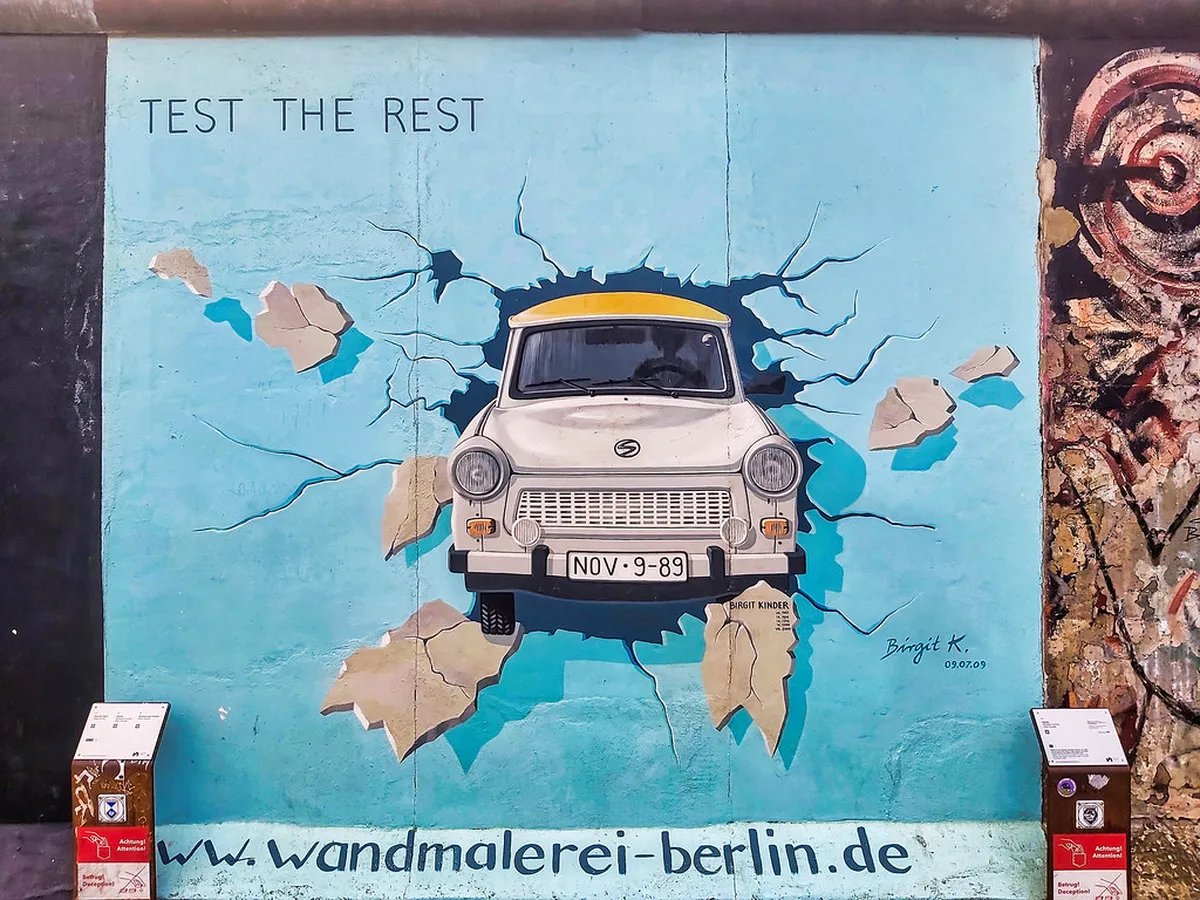
Birgit Kinder's "Test the Best" is the second essential stop. It shows a Trabant 601 — the quintessential East German car — bursting nose-first through the concrete. The Trabant was more than a vehicle; it was a symbol of the limited mobility and consumer restrictions of GDR life. Kinder's image transforms that symbol into a gesture of liberation, and the painting has since appeared on everything from postcards to fashion labels. Look for it roughly in the southern third of the gallery where the paint remains especially vivid.
Beyond these two, make time for Thierry Noir's cartoon-style heads, which are the earliest paintings on the wall — Noir had already been painting the western face before 1989. His bold outlines and primary colors stand in deliberate contrast to the political seriousness of the neighboring works. Small metal plaques near the base of the wall identify each artist's name and country of origin. Many of these works are among the free things to do in Berlin that reward travelers who slow down and read.
The Only Original: A Painting That Was Never Repainted
Most visitors assume they are looking at the 1990 originals, but in fact nearly every mural has been repainted at least once. The major restoration campaigns of 2000 and 2008/2009 required artists to recreate their works from scratch after the underlying masonry was repaired. Some artists painted faithful reproductions; others took the opportunity to revise their original concept. A small group refused entirely, leaving blank gaps in the wall surface that are still visible today.
One painting survived both campaigns without being redone: "Hands" by Scottish artists Margaret Hunter and Peter Russell. Conservation specialists have maintained the original paint film in place since 1990, using protective coatings rather than repainting. "Hands" is now the only artwork at the gallery that shows exactly what the original murals looked like when the ink dried in 1990 — faded, weathered, and partially covered by later graffiti. It reads very differently from its polished neighbors. The Berlin Wall Foundation marked the painting's 30th anniversary with a special conservation treatment and a public event with Hunter herself in September 2020.
Finding "Hands" requires looking for the deliberately aged surface: it is paler and more textured than the restored sections around it. The contrast makes it one of the most instructive spots on the entire wall for understanding what the gallery originally looked like and what was lost in the restoration process.
The Stories Behind the Artworks: Artist Perspectives
While the famous murals attract the longest queues of cameras, artists like Hans-Peter Dürhager and Ralf Jesse contributed works with equal depth. Dürhager's piece "Der müde Tod" (Tired Death) changed significantly in color scheme during the 2008/2009 renovation, shifting from the artist's original palette to a lighter treatment. These revisions sit at the center of an ongoing debate: should a restored monument look as it did in 1990, or should living artists be allowed to evolve their work? The comprehensive history of the East Side Gallery on Wikipedia offers deeper context on the 1990 creation and subsequent restoration campaigns.
In September 2025, the Berlin Wall Foundation hosted a panel discussion at the opening of the exhibition "Between Original and Copy: Change and Debates on the East Side Gallery." Artists Birgit Kinder, Jolly Kunjappu, Andy Weiss, and Gábor Simon gathered to discuss whether the gallery is primarily a place of remembrance, a monument, or a tourist attraction. That tension has no clean answer, but it makes the site more intellectually engaging than a conventional museum. The full preservation debate is documented online by the Stiftung Berliner Mauer if you want to go deeper before your visit.
Best Time to Visit: Avoiding the Crowds
The gallery is open twenty-four hours a day with no admission charge and no gates to close. Peak crowding happens between 10:00 and 17:00 from May through September, when organized tour groups arrive in waves. The best window for photography and quiet reflection is before 09:00, when the morning light hits the murals at a low angle and the riverbank is largely empty. Late evening visits in summer work equally well — the long Berlin dusk keeps the colors readable until past 21:00. Visit Berlin's official site offers current information on events and festivals that may affect crowd levels during your dates.
Photography etiquette matters more here than at most tourist sites. The wall stands on the exact location where people died attempting to cross the border. Selfie culture is common and you are free to photograph anything in a public space, but touching or leaning against the murals is prohibited. The concrete is a protected monument, and conservation work is expensive. If you see someone scratching a name into the surface, the Berlin Wall Foundation requests that you report it to the security staff or the visitor information center rather than confront the person directly.
Accessibility along the gallery path is reasonable but not perfect. The riverside sidewalk on Mühlenstraße is paved and flat for the full 1.3 kilometers, making it manageable for wheelchair users and pushchairs. The main challenges are the distance itself and the lack of seating mid-route. The renovated gatehouse that opened as a visitor information center in January 2025 provides seating, toilets, and a rest point roughly at the midpoint of the gallery — a significant improvement over the previous situation where the nearest facilities were at either end.
The East Side Gallery is a protected historical monument under Berlin law. Touching, leaning against, or writing on the murals is strictly prohibited. The concrete surface is fragile and restoration is expensive. If you witness vandalism or graffiti being applied, report it to security staff or the Berlin Wall Foundation visitor center rather than attempting to intervene directly. Violators face fines and potential legal action.
Guided Tours and Educational Programs
The Berlin Wall Foundation runs free public overview tours at the East Side Gallery on a regular schedule throughout the year. Tours last around 60 minutes, cover the main murals and the history of the border regime, and use audio guides to allow the guide to speak without amplification. School groups attend free of charge. Registration is not required for the public tours — check the current schedule on the Stiftung Berliner Mauer website before your visit, as dates change seasonally.
For smaller groups or specific thematic interests, the Foundation also offers private guided tours with individualized focus areas, including the restoration debate, the artists' biographies, or the neighborhood's urban development history. Private tours accommodate up to ten people and require advance booking. The meeting point for all guided tours is the Infomobile, stationed on the Spree riverside directly opposite Tamara-Danz-Straße — look for the blue information vehicle rather than the main street entrance.
The January 2025 opening of the gatehouse visitor information center at the northern end of the gallery added a permanent base for tour logistics. The building itself is historically significant: it was integrated into the border fortifications in 1977 and used by GDR border guards and the People's Police before serving as a souvenir shop for twenty years after reunification. The renovation was carried out by the Berlin Wall Foundation and the Wüstenrot Foundation, and the center now holds permanent educational displays on the gallery's creation and preservation. Entry to the information center is free.
Urban Development and the Future of the Monument
The gallery has faced sustained pressure from the Mediaspree development corridor, a wave of luxury construction along the Spree riverfront that accelerated in the 2000s. The most controversial episode came in 2013 when sections of the wall were physically removed to create access roads and a boat landing stage for what was then the O2 World Arena (now the Uber Arena). Protesters surrounded the wall during the demolition, and the phrase "Mediaspree versenken" (Sink Mediaspree) became a slogan for Berlin's anti-gentrification movement. Four artworks were relocated to a nearby green space; the gaps where they were removed remain visible.
In November 2018 the State of Berlin transferred the entire land parcel — including wall elements and the adjacent green space — to the Berlin Wall Foundation, removing it from commercial development risk. The Foundation is now the permanent steward, responsible for maintenance, monument preservation, and public education. Future plans focus on better interpretive signage, new educational displays, and the ongoing mural restoration programme launched in September 2025. Details on the relocation of the four moved sections are published by the Stiftung Berliner Mauer for anyone wanting the full documentary record.
What to Do Nearby: Exploring Friedrichshain and Kreuzberg
After finishing the wall walk, you are positioned at one of Berlin's best transition points between two distinct neighborhoods. Cross the Oberbaumbrücke — the double-decked Gothic Revival bridge that connects the two districts — and you enter Kreuzberg, famous for its Turkish food markets, independent bookshops, and dense concentration of bars. The bridge itself carries U-Bahn line U1 on its upper deck and pedestrian and cycle traffic below; the two giant hands playing scissors-paper-stone mounted on the bridge structure represent the playful rivalry between Friedrichshain and Kreuzberg. Views of the Spree and the gallery from the bridge are excellent.
Staying on the Friedrichshain side brings you into the Simon-Dach-Straße area, the neighborhood's main drag of restaurants and cafes. The RAW-Gelände, a former railway repair yard a few minutes' walk north, has been repurposed into an alternative culture complex with climbing gyms, flea markets at weekends, and a cluster of clubs. The Uber Arena sits directly opposite the gallery on the northern bank, hosting major concerts and sporting events that can make the surrounding streets very busy on event nights. Plan your visit around arena schedules if you want to avoid the post-concert crowds. For a fuller picture of the area, the Berlin neighborhoods guide covers both districts in detail.
Combine this with our ultimate Berlin guide for a complete trip plan.
Frequently Asked Questions
Is the East Side Gallery free to visit?
Yes, the East Side Gallery is entirely free to visit and open to the public at all times. It is located on a public sidewalk along Mühlenstraße, making it one of the most accessible historical sites in Berlin. No tickets or reservations are required to walk the length of the gallery.
How long does it take to walk the East Side Gallery?
Walking the full 1.3-kilometer length of the gallery typically takes between 45 and 60 minutes. This timeframe allows you to stop and admire the major murals while taking photographs along the way. If you read the historical information boards, you may want to budget closer to 90 minutes.
Can I touch or paint on the East Side Gallery?
No, you are not allowed to touch, lean on, or paint over any of the murals at the site. The gallery is a protected historical monument and any form of graffiti is considered vandalism. Security guards and cameras are often present to ensure the preservation of the artwork for future generations.
Are there public toilets or cafes at the East Side Gallery?
There are no public toilets directly on the gallery path, but facilities are available inside the nearby Ostbahnhof station. You will find several cafes and restaurants located at both ends of the gallery near Warschauer Straße and Ostbahnhof. Many visitors grab a coffee before starting their walk along the river.
The East Side Gallery is more than just a collection of paintings on a concrete wall in the heart of Berlin. It serves as a living testament to the power of art to overcome division and inspire hope for a better future. By visiting this site, you connect with the history of the Cold War while celebrating the creative spirit of reunification. Make sure to include this essential stop in your plans to truly understand the soul of modern Berlin.
You might also like


Continue reading
More guides you'll find useful