Charlottenburg Palace: The Ultimate Visitor Guide
Plan your visit to Charlottenburg Palace with our guide to the Old Palace, New Wing, and Gardens. Includes ticket prices, opening hours, and expert travel tips.
On this page
Charlottenburg Palace
Charlottenburg Palace stands as the largest and most magnificent royal estate in Berlin today. This former summer residence offers a stunning look into the lives of the Prussian kings and queens. Visitors can explore grand halls, lush gardens, and hidden royal tombs across the massive grounds. If you are planning things to do in Berlin, this historic landmark is a top priority.
The estate blends Baroque and Rococo architecture with a sprawling public park that locals love. Walking through the gates feels like stepping back into a world of royal elegance and power. Every room tells a story about the people who shaped modern Germany over several centuries. This guide provides all the practical details you need for a perfect day at the palace.
History of Charlottenburg Palace
The story of the palace began in 1695 with Sophie Charlotte, the first Queen consort in Prussia. She commissioned a small summer house that eventually grew into a massive palace complex. Sophie Charlotte was an accomplished musician who played the harpsichord and sang Italian opera, and she turned the court into a hub for philosophers and artists — including the celebrated scholar Gottfried Wilhelm Leibniz. Her husband, King Frederick I, renamed the estate Charlottenburg in her honor after her early death at just 36 years old.
Two royal women shaped Charlottenburg more than anyone else, and understanding their different influences helps you read the palace at a glance. Sophie Charlotte drove the original Baroque ambitions of the main building and its central dome. Queen Louise, beloved by Prussian subjects and mourned across Europe when she died at 34 in 1810, is tied to the quieter, Neoclassical beauty of the Mausoleum and the intimate winter chambers in the New Wing redesigned by Karl Friedrich Schinkel. These two women left the palace with two distinct personalities — grand and theatrical in the central block, tender and restrained in the northern corners.
Frederick the Great added the New Wing in the 1740s to accommodate his love for Rococo style and French painting. Later rulers expanded the gardens and added structures like the Mausoleum. The palace suffered heavy damage during the air raids of World War II in 1943. Dedicated restoration work, guided by original building records and salvaged furnishings, has since returned the rooms to their royal splendor.
The Old Palace (Altes Schloss) Highlights
The Old Palace, or Altes Schloss, contains the original Baroque apartments of the royal family. Visitors can see the stunning Silver Vault, which houses surviving pieces of royal dinnerware — around 100 intact table services in gold, silver, glass, and porcelain that give a vivid sense of the scale of Prussian court dining. The Porcelain Cabinet is another highlight, filled with thousands of delicate blue-and-white items that cover every wall from floor to ceiling. You can find detailed information on the Charlottenburg Palace – Old Palace (Official) website.
Note that tickets to the Old Palace come with a fixed admission time slot. You book a specific entry window when you purchase, so online advance booking is strongly recommended in summer to secure your preferred slot. This timed entry applies to both the single Old Palace ticket and the charlottenburg+ combined pass.
The palace is closed on Mondays and all entry times are fixed for the Old Palace. Book tickets online at least one day in advance, especially during peak summer months (May–September) when timed slots sell out by midday.
The crown jewels and royal regalia are displayed here alongside personal treasures like the elaborately decorated snuffbox collection amassed by Frederick the Great. These exhibits make it one of the best museums in Berlin for anyone interested in Prussian history. The 360-degree panorama of the palace courtyard, accessible digitally via the SANSSOUCI app, adds context for visitors who want to understand the full layout before they walk in.
The Fortuna Statue and the Best Photo Spots
On the dome of the Old Palace, a golden figure of the goddess Fortuna balances on a sphere with an outstretched cloak that catches the wind and rotates her like a weather vane. The current gilded statue dates from the twentieth century, inspired by the original 1711 weather vane, and has become an unofficial symbol of the entire Charlottenburg district. From the garden side, the statue is visible above the roofline at almost any angle, which makes it the most photographed single element of the complex.
Three spots reliably produce the best results for photographers in 2026. First, stand at the edge of the carp pond in the palace garden and shoot toward the main facade — the still water creates a clean reflection of the central dome in good light. Second, enter the Golden Gallery in the New Wing and photograph the pale green and gold ornament from the far end of the room looking back; it is 42 metres long and deeply symmetrical. Third, cross Spandauer Damm to the pavement directly in front of the palace gates and look up at the Fortuna statue against the sky — the angle and height compress into a single striking image without any foreground clutter.
Late afternoon light from around 16:00 in summer hits the west facade most favorably. The palace faces north, so the gardens see soft diffused light for most of the day, which works well for wide landscape shots of the grounds.
The New Wing (Neuer Flügel) and Rococo Splendor
The New Wing represents the peak of Frederician Rococo design in the 18th century. Frederick the Great used this space for grand festivals and important diplomatic meetings. The Golden Gallery is the most famous room here — 42 metres long with pale green walls and gold ornamental plasterwork that ranks among the most beautiful Rococo interiors in Europe. Check the Charlottenburg Palace – New Wing (Official) page for current exhibition details.
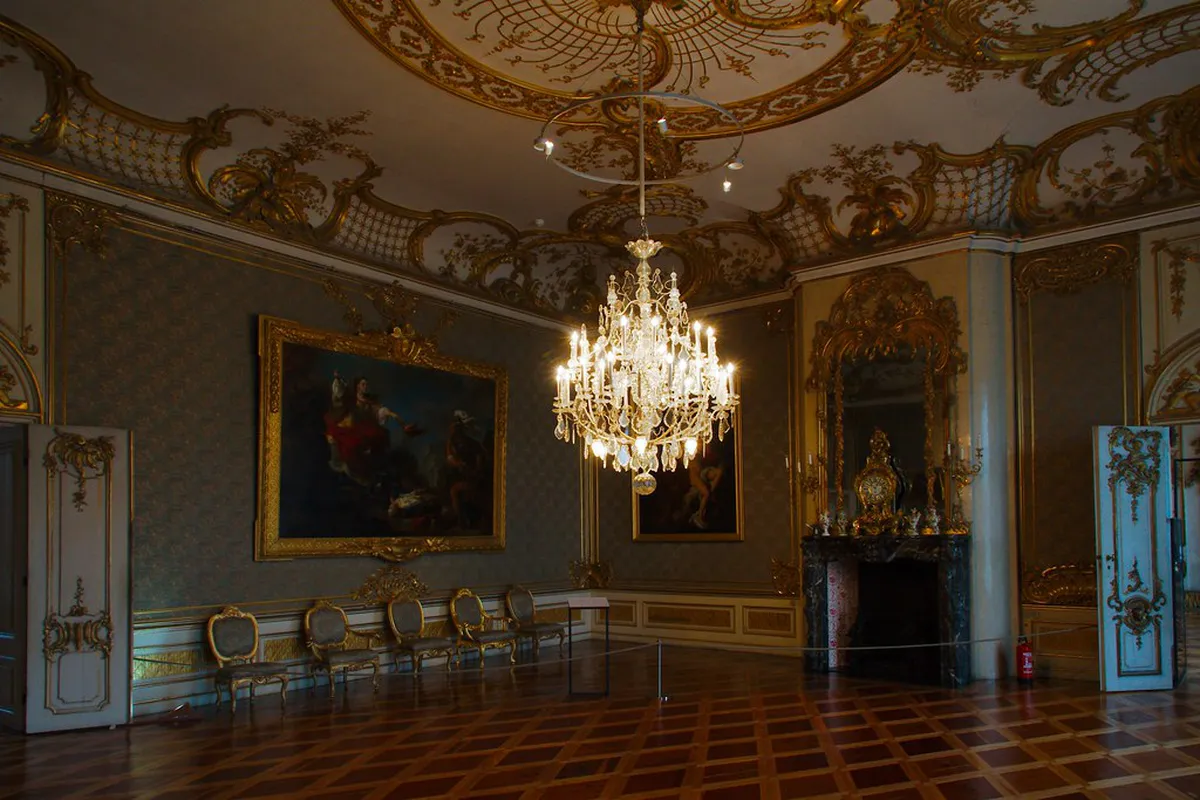
The White Hall served as the primary dining and banquet room for the royal court. Its high ceilings and bright light create a sense of vast, open space. Paintings by Antoine Watteau — one of the largest collections of 18th-century French painting outside France — are displayed throughout the wing, reflecting Frederick's personal art tastes. Each hall was designed to impress with the wealth and cultural ambition of the Prussian state.
The New Wing also contains the private apartments of Frederick William II and Queen Louise. Karl Friedrich Schinkel redesigned Queen Louise's elegant bedchamber in 1810, and it stands as a fine example of early Prussian furniture design. Visitors can trace the shift from flamboyant Rococo to the more restrained Neoclassical style by moving through the floors. The contrast between the two wings — exuberant gold in Frederick the Great's halls, quiet white in Louise's chambers — is one of the most instructive architectural journeys you can take in Berlin.
Exploring the Charlottenburg Palace Park and Gardens
The gardens at Charlottenburg Palace are among the most beautiful green spaces in Berlin. Siméon Godeau — a pupil of André le Nôtre, Louis XIV's principal gardener at Versailles — originally designed the park in a formal French Baroque style in 1697. Later changes introduced the English landscape style, creating a more natural and flowing environment. Visiting during the best time to visit Berlin ensures the flowers are in full bloom.
Entry to the palace park is free for all visitors throughout the year. The carp pond is a popular spot for photos, especially with the palace reflected in the water. Many locals use the wide paths for jogging or peaceful afternoon walks along the Spree river. The gardens provide a quiet escape from the busy city streets of the surrounding neighborhood.
The highlights in the park beyond the main palace are the Mausoleum, the Belvedere tea house, and the Neuer Pavillon — a small Neoclassical house modelled on a Neapolitan villa. A Palace Garden Café operates in the small Orangery, which is a good stop for coffee and cake between the outdoor sites. The manicured lawns and symmetrical hedges near the main facade are perfect for historical photography at any time of day.
The Mausoleum and Belvedere Tea House
The Mausoleum is a sacred site built to house the remains of Queen Louise, who died in 1810 at age 34 and was deeply mourned across Prussia. Her husband, King Frederick William III, had this Neoclassical temple constructed in the park and commissioned the leading sculptor Christian Daniel Rauch to carve an impressive marble funerary sculpture of Louise to decorate her sarcophagus. The building sits at the end of a quiet path lined with tall fir trees. Frederick William III is buried beside her, and the closed crypt beneath the anteroom holds additional family members.
The Belvedere Tea House is a small, elegant building built in 1788 near the river bank. It houses the largest collection of KPM porcelain — Königliche Porzellan-Manufaktur Berlin, the Royal Porcelain Manufactory — from the 18th and 19th centuries. Many tourists miss this section entirely, but the collection represents one of the finest assemblies of Berlin-made porcelain in the world. The tea house also gives a view of the surrounding garden landscape from the upper level.
Both the Mausoleum and the Belvedere are included in the charlottenburg+ combined ticket. They keep shorter, seasonal hours than the main palace buildings, so check the current schedule before walking to them — it would be a long walk to find them closed. Both structures are small and typically quick to visit, around 20 to 30 minutes each.
The Mausoleum and Belvedere have seasonal opening hours that differ from the main palace. Verify their specific hours on the SPSG website before planning your visit—some seasons they open later or close earlier than the Old Palace and New Wing.
Events at Charlottenburg Palace
The palace hosts a steady calendar of cultural events throughout the year that are worth timing your visit around. The most popular is the Charlottenburg Palace Christmas Market held each Advent season in the palace courtyard. Stalls selling hand-crafted arts and traditional festive food fill the cobblestone forecourt, and the illuminated Baroque facade behind them creates an atmosphere unlike any other Christmas market in Berlin.
During the summer months, the Orangery hosts evening concerts by the Berliner Residenz Orchester, where musicians perform in period-appropriate Baroque costume and wigs. These gala concerts pair live classical music with a full dinner and represent a theatrical way to experience the palace after regular visiting hours. Tickets sell out early, so booking several weeks in advance is advised.
The palace also runs themed children's birthday parties where young guests are dressed in court costumes and taught period dances. School classes receive a 30% discount on the group rate, and the Prussian Palaces and Gardens Foundation (SPSG) designs specific age-group tours for educational visits. Check the official SPSG events calendar before your trip to see what is scheduled for your travel dates in 2026.
Opening Hours and Seasonal Timing
The palace buildings are open Tuesday to Sunday from 10:00 to 17:30. All sections close on Mondays, so plan your itinerary accordingly. The palace is also closed on one annual works meeting day — in 2026 this falls on 02 September. Last admission is 30 minutes before the official closing time, which means your final entry is no later than 17:00.
The gardens have much longer opening hours, running from dawn until dusk every day of the year. The Mausoleum and Belvedere tea house keep shorter and more seasonal schedules that differ from the main buildings — check the official SPSG website before your visit to confirm their exact hours for your travel date. Arriving early in the morning helps you avoid the largest crowds and school groups, which typically arrive mid-morning.
Seasonal events like the Christmas market and summer concerts can affect access to certain parts of the courtyard. Photographers should note that the palace opens an hour after sunrise in summer, so early-morning golden-hour shots from inside the grounds are not possible on most days. Always verify the exact times on the SPSG website before arriving, as hours shift between the summer and winter seasons.
Admission Prices and the Charlottenburg+ Ticket
A single ticket for the Old Palace or the New Wing costs 12€ per person. The charlottenburg+ ticket costs 19€ and covers all buildings on the palace grounds for a single day — the Old Palace, the New Wing, the Mausoleum, the Belvedere, and the New Pavilion. You can find current Charlottenburg+ Ticket Details online to help you plan.
The break-even is straightforward: if you plan to visit both the Old Palace and the New Wing, the charlottenburg+ ticket saves you 5€ immediately (2 x 12€ = 24€ vs. 19€). If you add any of the smaller sites — Mausoleum, Belvedere — those would cost extra on single tickets, so the combined pass pays for itself after just two buildings. Buy online in advance, because the Old Palace ticket comes with a fixed timed entry slot that can sell out in peak summer weeks.
A charlottenburg+ Family Ticket is also available, covering up to 2 adults and up to 4 children aged 18 or under, and is sold at the palace registers rather than online. Reduced prices apply for students and visitors with disabilities on presentation of valid ID. Children under seven enter for free. Group rates apply to parties of 15 or more.
How to Get to Charlottenburg Palace
The palace is located at Spandauer Damm 10-22 in the western part of Berlin. Bus lines M45 and 109 stop directly at the Luisenplatz/Schloss Charlottenburg station. These buses connect easily to Zoologischer Garten station and other major transport hubs. Use the getting around Berlin guide for more tips on using the city network.
The nearest U-Bahn station is Richard-Wagner-Platz on the U7 line. From the station, it is a pleasant 15-minute walk to the main palace entrance. S-Bahn travelers can get off at Westend and walk about 10 minutes to reach the park gates. Check the VBB Timetable Information for real-time transit updates and schedules.
Paid parking spaces are available near the palace for those who prefer to drive — a parking map is available as a PDF on the SPSG website. Cycling is another excellent option, as the palace lies along several scenic bike paths. Plan for about 30 to 45 minutes of travel time from central Berlin.
Visitor Facilities: Luggage, Shop, and Multimedia App
The palace offers a limited number of free lockers for visitors to store bags and large umbrellas. The lockers accommodate smaller pieces of baggage up to 35 x 35 x 50 cm — standard day-pack size. Large suitcases and oversized backpacks cannot be stored and are not permitted inside the historic rooms. You will need a one-euro or two-euro coin to operate the locks, so carry change.
The SANSSOUCI app provides a free audio guide for your smartphone, available on the App Store and Google Play. It includes detailed descriptions of the rooms in English, German, French, Italian, Spanish, Chinese, Japanese, Polish, Ukrainian, and Russian. Download the app before you arrive, as the palace does not loan headphones and the in-building signal can be unreliable. The museum shop sells high-quality books, postcards, and Prussian-themed gifts, and is open during palace hours.
The New Wing is certified under the "Reisen für Alle" (Travel for All) accessibility standard and has elevator access. Assistance dogs are welcome throughout. Staff can provide specific support for mobility-impaired visitors at the information desk. Restrooms are located in the visitor center near the main entrance gates.
Nearby Museums and Attractions
The Charlottenburg district packs several world-class museums within a five-minute walk of the palace gates. Museum Berggruen sits directly across Spandauer Damm and houses works by Picasso, Klee, and Matisse. The Bröhan Museum next door focuses on Art Nouveau and Art Deco design from the early 20th century. The Sammlung Scharf-Gerstenberg, also opposite the palace, presents Surrealist and fantasy art.
The Käthe Kollwitz Museum has occupied the palace Theater Building since autumn 2022, making it the newest addition to the immediate palace precinct. Walking south for about 20 minutes along Schlossstrasse leads to the Kurfürstendamm shopping boulevard and the Kaiser Wilhelm Memorial Church. You can combine a full palace day with a trip to the Berlin Zoo, which is a short bus ride east. Exploring a Berlin neighborhoods guide can help you build a complete itinerary for the western districts.
The nearby Spree river also offers boat tours that provide an unusual view of the palace park from the water. The Charlottenburg area is safe and straightforward to navigate on foot or by public transport, and the cluster of attractions here makes it easy to fill an entire day without returning to the city center.
For the wider city overview, see our Berlin things-to-do guide.
Frequently Asked Questions
Which Charlottenburg Palace ticket should I buy?
If you want to see both the Old Palace and the New Wing, buy the Charlottenburg+ ticket for 19€. It saves you 5€ compared to buying two single tickets. This pass also includes entry to the Mausoleum and Belvedere during their seasonal opening times.
How much time do I need to see Charlottenburg Palace?
Plan for at least three to four hours to explore the main buildings and the gardens. If you visit the Mausoleum and the Belvedere Tea House, you may need a full half-day. Check the best museums in Berlin list for more timing tips.
Is the Charlottenburg Palace garden free to enter?
Yes, the public park and gardens are free to enter for everyone. It is a popular spot for walking, jogging, and picnics. The museum buildings require a paid ticket, but the outdoor grounds remain open to the public daily from dawn until dusk.
Can you take photos inside Charlottenburg Palace?
Photography for private use is allowed inside the palace buildings if you purchase a small photo permit. This permit usually costs 3€ and is valid for one day across all buildings. Flash photography and tripods are generally prohibited to protect the historic interiors.
Charlottenburg Palace is a must-see destination for anyone interested in European history and art. The combination of grand interiors and free public gardens makes it accessible for every traveler. Whether you love Baroque architecture or peaceful park walks, this estate has something special to offer. It remains a highlight of any trip to the German capital.
Be sure to check the seasonal hours and book your tickets online to save time. Consider staying in one of the best hotels in Berlin nearby for easy access to the grounds. The palace offers a deep connection to the royal past that still shapes the city today. Enjoy your journey through the royal history of Charlottenburg.
You might also like


Continue reading
More guides you'll find useful