10 Essential Facts and Visitor Tips for Checkpoint Charlie (2026)
Discover the history of Checkpoint Charlie, from the 1961 tank standoff to daring escapes, plus tips for visiting the Wall Museum and the original guardhouse.
On this page
10 Essential Facts and Visitor Tips for Checkpoint Charlie
During my first visit to Berlin, I was struck by how the city's scars remain visible in its modern landscape. Checkpoint Charlie stands as a powerful reminder of the division that once split this capital into two worlds. This guide was last refreshed in May 2026 to reflect the latest museum hours and local transit changes for visitors.
As we approach the 65th anniversary of the Berlin Wall's construction, understanding this site is more relevant than ever. You will find that the area is a mix of deep historical weight and modern commercial tourism. Our editors have reviewed the surrounding best things to do in Berlin to help you plan.
According to Berlin.de - Official Visitor Information, this remains one of the city's most visited landmarks. Whether you are a history buff or a casual traveler, these facts will help you navigate the complex legacy of the border.
Checkpoint Charlie: The Most Famous Berlin Wall Crossing
The division of Berlin during the Cold War created many points of tension across the city's fractured landscape. Standing at this intersection allows you to feel the weight of decades of intense geopolitical struggle between superpowers. Most travelers combine this stop with a walk to the nearby Berlin Wall and East Side Gallery sites.
This specific crossing point was the only gateway where Allied diplomats, military personnel, and foreigners could pass between East and West. It operated for nearly three decades, from the wall's construction in August 1961 until German reunification in October 1990. While several checkpoints existed around Berlin — including Checkpoint Alpha at Helmstedt and Checkpoint Bravo at Dreilinden — Charlie became the most internationally visible and politically charged of them all.
While the physical wall is mostly gone here, a double row of cobblestones in the street marks its former path. Walking across this line today is a simple act that would have been impossible for many just decades ago. Take a moment to read the outdoor informational panels that provide context on the many failed and successful escapes.
The cobblestone line marking the Wall's path is easy to miss. Look at the street surface carefully between Zimmerstraße and Mauerstraße — the double row of red-and-white stones runs east-west across the intersection. Photographers often capture visitors standing with one foot in what was East Berlin and one foot in what was West Berlin.
How Checkpoint Charlie Got Its Iconic Name
The name Checkpoint Charlie came from the Allied forces, not the East Germans. It follows the NATO phonetic alphabet: Checkpoint Alpha was the first Allied crossing at Helmstedt, Checkpoint Bravo was the second at Dreilinden in southwest Berlin, and Checkpoint Charlie — the letter C — was the third. The Soviets simply called it the "Friedrichstrasse Crossing Point," while East Germany's official name was the cumbersome "Grenzübergangsstelle Friedrich-/Zimmerstraße."
The Allied designation stuck precisely because it was easy to say and carried a certain laconic military clarity. When journalists, diplomats, and eventually tourists began referring to the checkpoint, they all used the same three words. That consistency helped fix the location in global memory during the most intense years of the Cold War.
The checkpoint sat at the junction of Friedrichstraße with Zimmerstraße and Mauerstraße in the Friedrichstadt neighborhood, a short walk southeast of the Brandenburg Gate and just a few hundred meters east of Potsdamer Platz. Its central position in the American occupation sector made it the natural focal point for Allied-Soviet confrontations.
Why Only Foreigners and Allies Could Cross Here
Checkpoint Charlie was never a checkpoint for ordinary Berliners. East Germany restricted it strictly to Allied military personnel, diplomats, and foreign nationals. Ordinary East German residents were required to use other crossing points like the Friedrichstraße train station, and even then, crossing was rarely permitted without specific government authorization.
For foreigners visiting before 1990, Checkpoint Charlie was effectively the only way to travel between East and West Berlin on foot or by car without risking your life. Non-military travelers on the Eastern side faced intense scrutiny — guards were known to confiscate newspapers, magazines, and any printed material that contradicted communist ideology. Vehicles were searched with mirrors and heat-scanning equipment to detect stowaways.
The Allied side operated quite differently. US, British, and French military police stationed there spent most of their time monitoring diplomatic traffic and briefing travelers before they crossed. Despite its global significance, the Allied side of the checkpoint remained deliberately minimal in size — a reflection of the Western position that the wall was neither permanent nor legitimate.
The Allied Shack vs. the East German Fortress
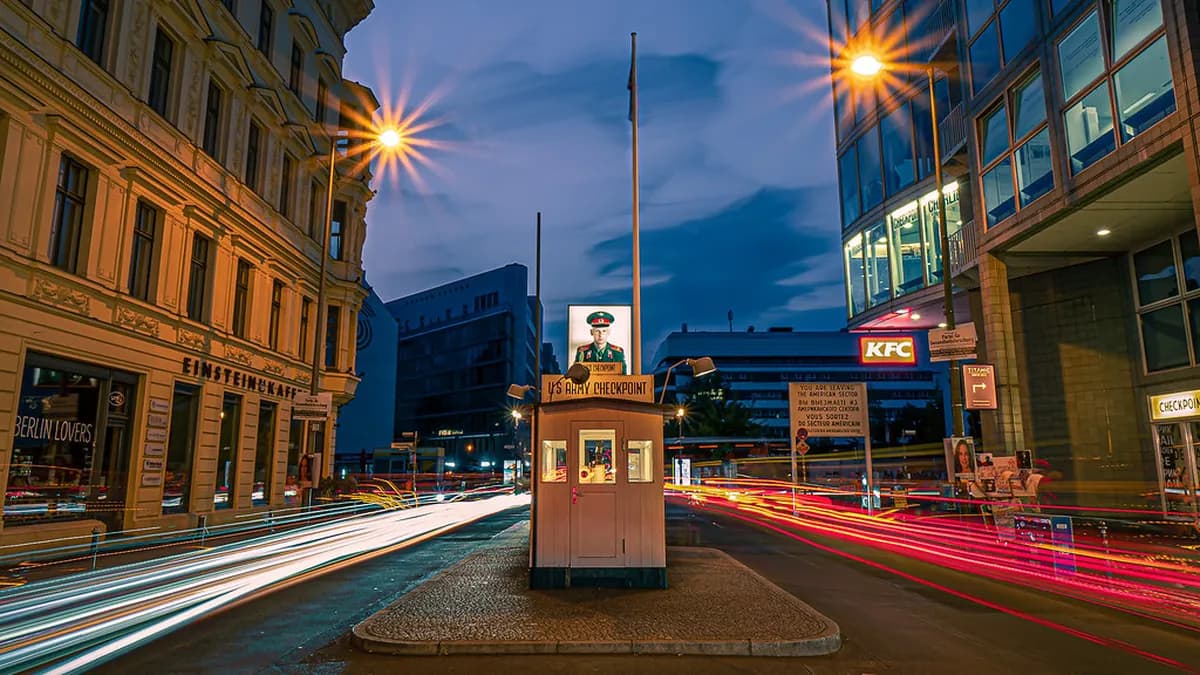
The contrast between the two sides of Checkpoint Charlie was stark and entirely intentional. The Allied guardhouse was a small prefabricated wooden shack with a few sandbags. It was kept this way on purpose: by refusing to build a permanent, imposing structure, the Western powers signaled that they did not recognize the Berlin Wall as a legitimate border. The original wooden shack was later replaced in the 1980s by a slightly larger metal building, but the principle of deliberate minimalism never changed.
The East German side told a completely different story. It featured guard towers, cement barriers, a vehicle search area, and a shed where departing vehicles were subjected to mirror inspections and heat scans to detect people hiding underneath or inside. The contrast was so visible that aerial photographs of the crossing became Cold War symbols in themselves — one side a modest wooden booth, the other a surveillance infrastructure.
None of the original Eastern structures survive at the intersection today. The replica guardhouse now standing in the street is based on the smaller 1961 original, not the larger metal version that replaced it. Historical photographs displayed on the surrounding information boards let you reconstruct what both sides actually looked like.
The 1961 Tank Showdown That Nearly Started World War III
The tensest moment in Checkpoint Charlie's history began on October 22, 1961, when US diplomat Allan Lightner attempted to cross into East Berlin to attend the opera. East German border guards demanded to see his passport. Lightner refused on the grounds that only Soviet officers — not East German ones — had authority to inspect his papers. He was initially turned back, only returning to the checkpoint with a complement of armed US soldiers and military jeeps. East German officials continued to block American entry, which forced US General Lucius Clay to escalate dramatically: ten M-48 tanks moved into position around Checkpoint Charlie.
The Soviets responded in kind. Three dozen T-55 tanks gathered near the eastern border. On October 27, ten of them rolled forward to face the American armor. For sixteen hours, the two sides stared each other down at point-blank range in one of the only armed confrontations between NATO and Warsaw Pact forces during the entire Cold War. The standoff ended only when President John F. Kennedy contacted Soviet Premier Nikita Khrushchev directly. Khrushchev agreed to withdraw his tanks first; the American M-48s followed minutes later. The crisis ended peacefully on October 28, 1961.
Ground markings near the intersection indicate roughly where the tanks were positioned during the standoff. Standing there puts the scale of the confrontation into perspective — these were not symbolic gestures but fully loaded combat vehicles manned by soldiers from two nuclear powers.
Daring Escapes and the Tragedy of Peter Fechter
Because Checkpoint Charlie was one of the few gaps in Berlin's barrier of walls, wire, and watchtowers, it attracted desperate East Germans searching for a way out. In April 1962, an Austrian named Heinz Meixner drove a rented Austin-Healey convertible to the checkpoint, lowered the windshield, and accelerated underneath the vehicle barrier at speed — with his East German girlfriend and her mother hidden in the car. They made it. Another man later repeated the stunt before the East Germans welded steel bars across the opening. These escapes required not just courage but detailed knowledge of the checkpoint's physical layout.
Not every escape ended in triumph. On August 17, 1962, eighteen-year-old Peter Fechter tried to climb the wall near Checkpoint Charlie and was shot in the pelvic area by East German guards. He fell back onto the Eastern side of the border, just meters inside the death strip. Because he landed within East German territory, American soldiers stationed nearby were officially prohibited from crossing to help him. West Berliners threw bandages over the wall. East German guards did not remove him for nearly an hour. He died in full public view. A memorial cross on Zimmerstraße marks the spot today and deserves a quiet moment when you visit.
The memorial to Peter Fechter is located near Checkpoint Charlie on Zimmerstraße. Some tour groups hurry past it without stopping. Standing there to read his story takes only a few minutes but transforms your understanding of what the Wall meant to ordinary people caught in impossible circumstances.
According to History.com, US military personnel were officially forbidden from aiding escapees. Yet in a late exception, shortly before the wall fell in 1989, an American serviceman named Eric Yaw smuggled an East German father and daughter through Checkpoint Charlie in the trunk of his car — risking his military career for a family he had just met.
Spy Swaps and Cold War Espionage at Checkpoint Charlie
Checkpoint Charlie played a direct role in some of the most dramatic prisoner exchanges of the Cold War. In February 1962, a high-profile swap took place simultaneously at two Berlin locations. At the Glienicke Bridge on the city's western edge, captured American U-2 spy plane pilot Francis Gary Powers was exchanged for Rudolf Abel, a Soviet intelligence officer convicted of espionage in New York. At the same moment, Checkpoint Charlie served as the release point for Frederic Pryor, an American economics student who had been arrested by the East German Stasi and incorrectly identified as a spy. Pryor walked through the checkpoint to freedom while Powers crossed the bridge a few kilometers away. The dual-site swap, coordinated to the minute, illustrates how central Checkpoint Charlie was to Cold War back-channel diplomacy.
The checkpoint's role as a Cold War trading post became a popular motif in espionage fiction. John le Carré's 1963 novel The Spy Who Came in from the Cold opens at a checkpoint modeled on Charlie, and the 1965 film adaptation made the bleak crossing iconic for a generation of viewers. The atmosphere le Carré captured — fog, tension, the arbitrary power of border guards — was not invented. It was reported by journalists and diplomats who crossed here regularly.
The checkpoint was used for a handful of other prisoner swaps over the years, and its reputation as a place where Cold War deals were quietly made or broken never fully went away. Even today, standing at the intersection on a gray November evening, it is easy to understand why this particular street corner became such a durable metaphor for geopolitical division.
Exploring the Wall Museum (Haus am Checkpoint Charlie)
The Haus am Checkpoint Charlie was founded by human rights activist Rainer Hildebrandt shortly after the wall went up in 1961. It opened on June 14, 1963, making it one of the oldest continuously operating Cold War museums in Berlin. Its collection is vast and sometimes chaotic, reflecting the urgency of the resistance movement that built it. You will find everything from miniature submarines to hollowed-out surfboards, hot-air balloons, and a modified Austin-Healey similar to the one used in the Meixner escape.
The museum provides deep context on the Berlin Wall's history through personal artifacts and survivor testimonies. It is one of the few places where you can see the technical ingenuity required to bypass Soviet security — some of the escape vehicles on display were engineered to professional standards. Be prepared for a lot of reading; the exhibits are heavily text-based and presented in multiple languages including German, English, and Russian.
Entry costs approximately €17.50 per adult in 2026. The museum is open daily from 10:00 to 20:00. The gift shop sells a wide variety of books and historical reproductions. If you plan to bundle multiple Berlin Cold War sites in one day, consider using a one-day Berlin itinerary to sequence the Wall Museum alongside the nearby Topography of Terror and the Tränenpalast, which is free to enter and a ten-minute walk north.
Where to Find the Original Guardhouse
The structure standing at the intersection today is a replica installed in 2000. The original guardhouse was removed in a ceremony on June 22, 1990, attended by French, British, American, German, and Soviet dignitaries. US Secretary of State James Baker said at the event: "For 29 years, Checkpoint Charlie embodied the Cold War. We meet here today to dismantle it and to bury the conflict that created it." That guardhouse is now on permanent display at the Allied Museum (AlliiertenMuseum) in the Dahlem district of southwest Berlin.
The Allied Museum is free to visit and covers the broader history of the Western Allied presence in Berlin from 1945 to 1994. It holds the original wooden guardhouse along with a Hastings aircraft used in the Berlin Airlift, a section of the spy tunnel dug under East Berlin by the CIA and British intelligence, and a full-scale preserved watchtower from the Berlin Wall itself. The nearest U-Bahn station is Oskar-Helene-Heim on the U3 line. Check the official website before visiting for current opening hours and any special exhibitions.
It is worth being clear to fellow travelers: the guardhouse at Checkpoint Charlie was replaced by a larger metal structure in the 1980s, and the replica installed in 2000 is based on the smaller original 1961 wooden version — not the metal one that was removed in 1990. The Allied Museum holds the metal building. The replica at the crossing represents the earlier design.
Planning Your Visit and Getting There
Getting to Checkpoint Charlie is straightforward. The U6 subway line stops at Kochstraße station, which is a ninety-second walk from the crossing. Bus lines M29, 248, and M41 also stop along the Friedrichstraße corridor and connect to the central train station and Potsdamer Platz. If you are staying in Mitte or Kreuzberg, walking is a realistic option. The Berlin public transport guide covers day-pass pricing, which makes sense if you plan to combine the checkpoint with the Allied Museum in Dahlem.
The outdoor crossing is open around the clock and free to visit every day of the year. Most visitors find one to two hours is sufficient for the outdoor sights and the Asisi Panorama (approximately €11, open daily 10:00–18:00). Add two more hours if you plan to visit the Wall Museum. The area is busiest between 11:00 and 15:00 when tour buses arrive; before 09:00 and after 17:00, crowds thin significantly and the atmosphere is more reflective.
A half-day in the Friedrichstadt area works well if you walk north to the Tränenpalast (former border transit hall, free entry) and south ten minutes to the Topography of Terror (free, open 10:00–20:00), which documents the Nazi SS and Gestapo headquarters that once stood on that ground. The Museum Island Berlin area is a 20-minute walk north and rounds out a full cultural day in central Berlin.
What to Skip and Common Tourist Pitfalls
Avoid paying for photos with the actors dressed in military uniforms at the crossing point. These performers are not official historians and often charge high prices for a simple smartphone picture. Instead, focus your time on the free outdoor gallery that explains the site's true historical significance.
Be wary of vendors selling "authentic" pieces of the Berlin Wall in the surrounding souvenir shops. Many of these colorful rocks are simply painted concrete and lack any real historical provenance or value. If you want to see the real wall, head to the East Side Gallery instead.
The restaurants directly adjacent to the checkpoint are often overpriced and cater specifically to large tour groups. Walk two blocks away into the side streets of Kreuzberg to find much better local dining options. This small effort will save you money and provide a more authentic taste of modern Berlin life.
Frequently Asked Questions
Is the current Checkpoint Charlie guardhouse original?
No, the current guardhouse is a faithful replica installed in 2000. The original structure was removed in 1990 and is now displayed at the Allied Museum in the Dahlem district of Berlin. You can visit the original for free to see its authentic details.
Can you still see the Berlin Wall at Checkpoint Charlie?
There is no standing section of the original wall left at the intersection itself. However, a double row of cobblestones in the ground marks the exact path where the wall once stood. For standing sections, visit the nearby Topography of Terror or the 10 Best Museums in Berlin: The Ultimate 2026 Visitor's Guide list for more locations.
How much does it cost to visit Checkpoint Charlie?
Viewing the outdoor crossing point and the historical information panels is completely free for all visitors. The nearby Wall Museum costs approximately €17.50 per adult, while the Asisi Panorama charges around €11. Budgeting for these museums is recommended if you want a deeper historical experience.
Checkpoint Charlie remains a vital landmark that captures the tension and triumph of a city once divided. By visiting the replica guardhouse and the nearby museums, you gain a tangible connection to Cold War history. I hope this guide helps you navigate the site with a deeper understanding of its complex past.
Whether you are there for the photos or the deep historical research, the Friedrichstadt area has much to offer. Take the time to explore the side streets and memorials to fully appreciate the resilience of the Berlin people.
You might also like

Continue reading
More guides you'll find useful