Nymphenburg Palace Travel Guide
Plan nymphenburg palace with top picks, neighborhood context, timing tips, and practical booking advice for a smoother trip.
On this page
Nymphenburg Palace
Nymphenburg Palace is one of the largest Baroque palace complexes in Europe and the former summer residence of the Bavarian royal family. It sits about 8 km northwest of Munich's city center, surrounded by a free-entry park that locals use year-round for cycling and picnics.
The estate covers 180 hectares and holds four park pavilions, three museums, a working porcelain manufactory, and 21 state rooms open to the public. A full visit takes three to five hours depending on how much of the park you explore.
This guide covers everything you need for a well-planned 2026 visit: what to see inside, which ticket to buy, how to reach the palace, and what most visitors miss. For a broader overview of the city, see our guide to 12 Best Things to Do in Munich.
History: The Wittelsbachs and Their Summer Retreat
Construction began in 1664 when Elector Ferdinand Maria commissioned a modest Italianate villa to celebrate the birth of his heir, Max Emanuel. The name Nymphenburg — "Castle of the Nymphs" — was a deliberate Baroque flourish, evoking elegance and the mythological female nature spirits that appear throughout the ceiling frescoes inside.
Max Emanuel later expanded the original villa into the sprawling palace visible today, adding the north and south pavilions and importing architects from across Europe. Successive rulers kept adding to it through the 18th century. Elector Maximilian III Joseph gave the Great Hall its defining Rococo decoration, which has remained unchanged since the mid-1700s.
The Wittelsbach family ruled Bavaria for over 700 years and supplied two Holy Roman Emperors. They lost political power in 1918 at the end of World War I, but remarkably still occupy a private wing of Nymphenburg Palace. As of 2025, that private royal residence can be rented through Kempinski Hotels starting at €25,000 per night — a detail that underlines how unusual this place is among European palaces still inhabited by their founding families.
Must-See Nymphenburg Attractions Inside the Palace
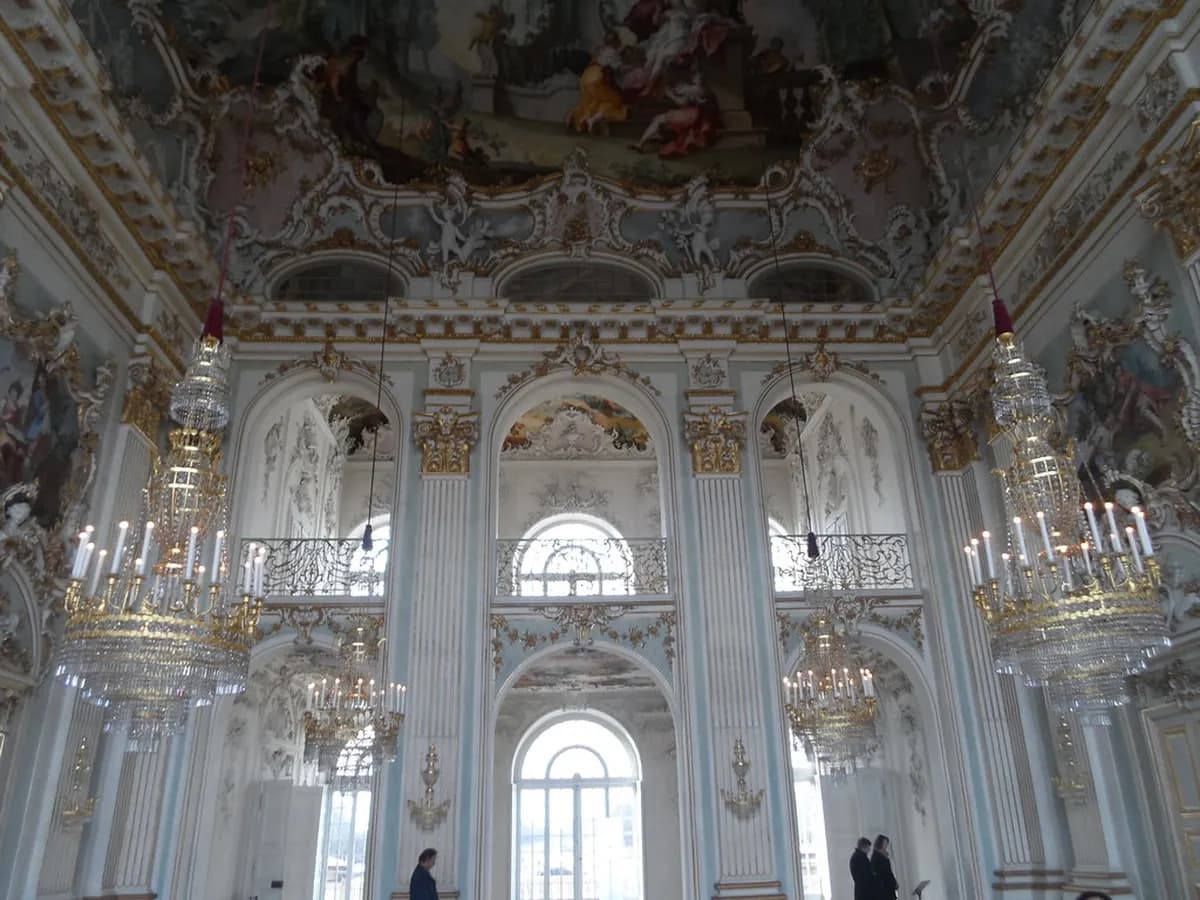
The main palace tour covers 21 state rooms. The Great Hall (Steinerner Saal) is the undeniable highlight: a soaring two-story Rococo masterpiece covered in gilded stucco, elaborate frescoes, and ceiling paintings celebrating Wittelsbach rule. It is the first room you enter and nothing inside the palace matches it for scale.
King Ludwig I's Gallery of Beauties is one of the most discussed rooms in any Bavarian palace. Court painter Joseph Karl Stieler produced 36 portraits of women chosen by Ludwig I for their beauty — not just noblewomen, but also a dancer and a shoemaker's daughter. The most famous is Lola Montez, the Irish dancer whose relationship with Ludwig I eventually contributed to his abdication. The gallery sits in the south pavilion and is included in the main palace ticket.
The Queen's Bedchamber is smaller but carries significant historical weight. King Ludwig II — the so-called "Fairy Tale King" who built Neuschwanstein Castle — was born in this room in 1845. The original Empire-style furnishings and silk canopy are intact. For context on Ludwig II's broader legacy, the 10 Best Museums in Munich guide covers the Residenz collections that overlap with his story.
Two other rooms are worth slowing down for. The North Antechamber retains its French-inspired decoration from the period when Max Emanuel returned from exile in France, making it one of the last surviving rooms in that style. The Chinese Lacquer Cabinet is a small but exquisite example of the 18th-century European fascination with East Asian design.
Museums, Art, and Culture at Nymphenburg
The Marstallmuseum occupies the former royal stables and holds one of Europe's most important collections of state coaches and sleighs. The Coronation Coach of Emperor Charles VII is the standout piece — its scale and gilded craftsmanship make it easy to spend 30 minutes in this room alone. Admission is included with the Combination Ticket or can be purchased separately. Full details are on the Nymphenburg Palace website.
On the upper floor of the Marstallmuseum sits the Museum of Nymphenburg Porcelain (Bäuml Collection). The Nymphenburg Porcelain Manufactory is still operating on the palace grounds today, owned by the Wittelsbach family, and every piece it produces is still made entirely by hand. The museum's 18th-century figurines and tableware give a strong sense of the craftsmanship that made Nymphenburg porcelain famous across Europe. More information is available on the Nymphenburg Palace website.
The Museum of Mankind and Nature (Museum Mensch und Natur) occupies the north wing and covers evolution, geology, and biodiversity. It is a genuinely good natural history museum and well-suited to families with children, though be aware that exhibits and signage are presented primarily in German. A separate admission ticket is required.
The Park at Munich Nymphenburg Palace
The park is free to enter and covers the full 180-hectare estate. It was originally laid out in the formal French style by Dominique Girard, a student of Versailles' designer André Le Nôtre. In the 19th century it was partly redesigned in the looser English landscape style, so the area closest to the palace is more structured while the outer reaches open into meadows and woodland.
A central canal runs from the palace toward the horizon, lined with mature trees. Swans and herons are common along the water. The park is heavily used by locals for walking and cycling, especially on summer mornings before 09:00, which is when it is quietest and the light is best for photography.
Four park pavilions are scattered through the grounds and are included with the Combination Ticket. Amalienburg is the most remarkable — a small Rococo hunting lodge with a circular Hall of Mirrors that rivals anything inside the main palace. Its intimacy makes the craftsmanship easier to appreciate than in the larger state rooms. Badenburg is a royal bathing house with a tiled indoor pool. Pagodenburg has an East Asian-inspired lower floor. Magdalenenklause is a deliberately ruined hermitage, built as a meditation retreat. All four are closed mid-October through March. The official park map is available on the Nymphenburg Palace website.
Adjacent to the northwest edge of the park is the Munich Botanical Garden, home to over 16,000 plant species and an impressive greenhouse complex. It requires a separate admission ticket and is open daily except 24 and 31 December. More information is at the Munich Botanical Garden website.
Family-Friendly and Budget-Friendly Options
The palace park is free with no booking required, making it one of Munich's best free half-days for families. Children enjoy the canal, the open meadows for running, and spotting wildlife along the waterways. The Museum of Mankind and Nature is specifically designed with families in mind and has hands-on exhibits, though the German-only labelling limits its usefulness for non-German-speaking children.
For visitors on a tight schedule or budget, the park-only visit requires no ticket at all. The pavilion exteriors and the canal views are visible without any purchase. The main palace ticket (palace state rooms only, no museums or pavilions) costs €10 for adults in 2026, while the Combination Ticket covering the palace, Marstallmuseum, porcelain museum, and all four park pavilions costs €15 for adults. Children under 18 enter free. Buying online via the Nymphenburg Palace Ticket Shop is strongly recommended — walk-up queues can be long, and tickets are date and time specific so you need to arrive on schedule.
Audio guides are available for a small additional fee at the time of booking. This is worth emphasizing: the state rooms have almost no written descriptions in English. Without the audio guide, many of the most historically interesting rooms — including the North Antechamber and the Chinese Lacquer Cabinet — make little sense. Most visitors who skip the audio guide regret it.
The audio guide is essential for understanding the palace's history. Available in multiple languages for €3.50, it provides context for each state room that written plaques do not offer. Without it, even the Great Hall's intricate frescoes remain just beautiful surfaces.
How to Plan a Smooth Nymphenburg Visit
Tram 17 is the standard route. From Munich Hauptbahnhof (central station) take Tram 17 toward Amalienburgstraße and exit at Schloss Nymphenburg. The journey takes about 26 minutes and runs every 10 to 15 minutes. From the tram stop it is a 10-minute walk to the palace entrance. Clear signs direct you from the stop. If you have mobility issues, a taxi or rideshare drops you closer to the gate.
Tram 17 is the fastest public transit option to Nymphenburg from Munich Hauptbahnhof. 2026 ticket prices: €10 for the main palace (state rooms only), €15 for the Combination Ticket covering the palace, Marstallmuseum, porcelain museum, and all four park pavilions. Children under 18 enter free. Book online to skip walk-up queues.
Arriving when the palace opens — 09:00 from April through mid-October, 10:00 in winter — gives you a clear 45 minutes before the first tour groups arrive around mid-morning. Mondays are workable for the park but avoid them if you want the state rooms: some museums have reduced hours or closures. The palace is closed on 1 January, Shrove Tuesday (17 February 2026), 24–25 December, and 31 December. Current seasonal hours are listed on the Nymphenburg Palace website.
On-site storage lockers are available for large bags, which are not allowed inside the state rooms. Food and drink are also prohibited in the historic rooms. Two restaurants operate on the grounds: Schlosscafé im Palmenhaus inside the park and Schlosswirtschaft Schwaige in the south wing — both good for a post-visit lunch. Plan for at least three hours if you are doing the palace and Marstallmuseum. Add another 90 minutes if you want to reach Amalienburg in the park.
Nymphenburg versus Munich Residenz is a common planning dilemma. The Residenz sits downtown and packs more concentrated museum content into a smaller space. Nymphenburg wins on atmosphere, the park, and the Gallery of Beauties — it rewards visitors who want a full day rather than a tight two-hour cultural hit. If you are comparing the two for a short trip, the Residenz fits more naturally into a walking itinerary of the old town, while Nymphenburg works best as a dedicated excursion. Both are covered in our overview of the 12 Best Things to Do in Munich.
Frequently Asked Questions
How much time should you plan for Nymphenburg Palace?
You should plan at least three to four hours for a complete visit. This allows enough time to tour the main palace rooms, explore the Marstallmuseum, and walk to at least two park pavilions. If you enjoy long walks in gardens, a full morning is ideal.
Is Nymphenburg Palace worth including on a short itinerary?
Yes, it is definitely worth it for the unique combination of architecture and landscape. Even on a 3 Days in Munich, the palace offers a necessary contrast to the bustling city center. The park is free to enter if you only want a quick look.
What should travelers avoid when planning a visit?
Avoid visiting on Mondays if you want to see the interior museums, though the park remains open. Do not forget to wear comfortable walking shoes, as the grounds are extensive. Also, try to avoid the midday heat in summer since the park has many open, unshaded paths.
For the bigger picture, see our complete Munich guide. You might also like the Marienplatz and Old Town and the English Garden.
Nymphenburg Palace rewards visitors who take their time. The Great Hall and Gallery of Beauties are the headline draws, but the park pavilions — especially Amalienburg — and the working porcelain manufactory make this one of the most layered royal sites in Germany.
Buy the Combination Ticket, book the audio guide, and arrive early. Check Munich Weather By Month Travel Guide if you are planning a park-heavy visit, since the pavilions close for winter and the gardens look very different in each season.
You might also like


Continue reading
More guides you'll find useful