Marienplatz Munich Travel Guide
Plan marienplatz munich with top picks, neighborhood context, timing tips, and practical booking advice for a smoother trip.
On this page
Marienplatz Munich
Marienplatz is the beating heart of Munich and the most famous public square in Bavaria. Since the city's founding in 1158, this central space has hosted medieval grain markets, royal tournaments, championship celebrations, and some of Europe's most beloved Christmas markets. Every visitor to Munich passes through it at least once — most return several times.
The square connects the major pedestrian shopping streets, sits above the city's busiest transport interchange, and places you within a five-minute walk of a dozen major landmarks. Whether you have two hours or a full day, knowing what to prioritise — and when to show up — makes a real difference. Pair this guide with our full list of 12 Best Things to Do in Munich to plan the rest of your visit.
History of Marienplatz: The heart of Munich
When Munich was founded around 1158, Marienplatz was little more than a busy street crossing. The salt road — the trade route whose tolls funded the city's creation — met the older north-south road here on a low hill called Petersbergl. Monks settled nearby and gave the young settlement its name: apud munichen, meaning "with the monks."
For several centuries the square served as Munich's main market, known simply as the Markt or Schrannenplatz (grain market). Eggs, flour, wine, and fish were sold here daily. The fish trade explains why the corner fountain is still called the Fischbrunnen. The square only received its current name, Marienplatz, in 1854, two years after the market relocated to Blumenstrasse.
Much of the medieval square was damaged or destroyed during World War II. The New Town Hall survived largely intact; the Old Town Hall had to be substantially rebuilt. The pedestrian zone that gives Marienplatz its relaxed, piazza-like atmosphere today was created in the late 1960s and early 1970s during a comprehensive redevelopment of the city centre.
The New Town Hall and the Old Town Hall
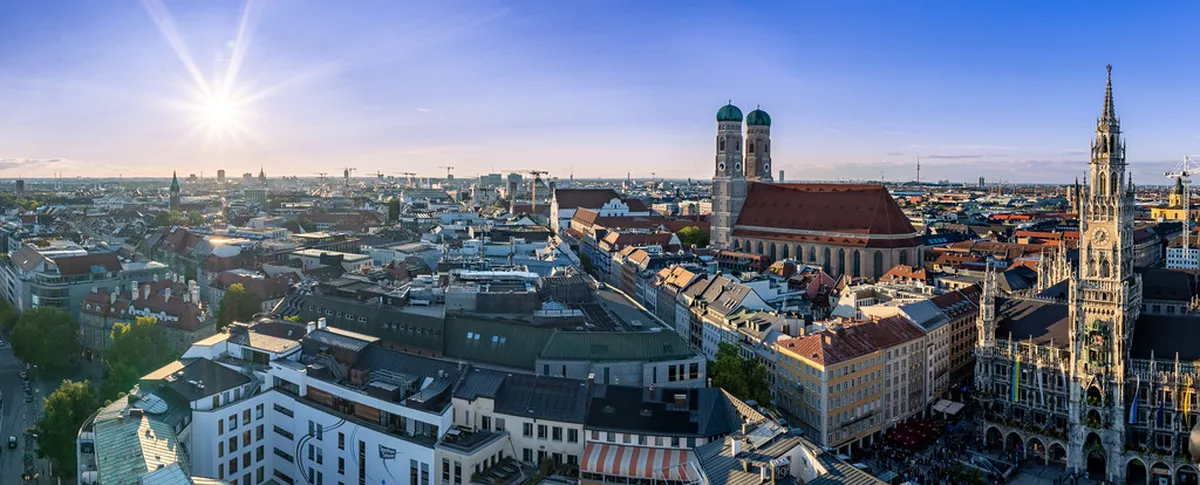
The New Town Hall (Neues Rathaus) dominates the northern side of the square with a 100-metre facade of neo-Gothic stonework. Despite its medieval appearance, it was built between 1867 and 1909, designed by architect Georg von Hauberrisser. Today it is the seat of Munich's Lord Mayor and city council. On weekdays you can walk into the courtyard, which is free and surprisingly quiet compared to the plaza outside.
The observation deck at the top of the New Town Hall tower is accessible by elevator and costs around €6. The views across the Old Town rooftops are excellent, though you are looking outward rather than at the building itself. Hours in 2026 are typically 10:00–20:00 in summer and 10:00–17:00 in winter, but check the entrance before you queue.
The Old Town Hall (Altes Rathaus) closes off the eastern side of the square. It is almost 400 years older than its neighbour and was the city's seat of government until 1847. The building incorporates a medieval city gate and a large Gothic ballroom still used for ceremonial events. The tower houses the Munich Toy Museum, a small but charming collection of historic model trains, dolls, and tin toys — a good option for families with young children.
The Glockenspiel: Show times and what you actually see
The Rathaus-Glockenspiel has been running since 1908. It sits in the tower of the New Town Hall and consists of 43 bells and 16 mechanical figures arranged on two tiers. The performance lasts about fifteen minutes and re-enacts two events from Munich's history: the marriage of Duke Wilhelm V to Renate of Lorraine in 1568, depicted by a jousting tournament in the upper tier, and the Schäfflertanz (Cooper's Dance) in the lower tier, which recalls how barrel-makers danced through the streets to cheer Munich citizens after a plague outbreak.
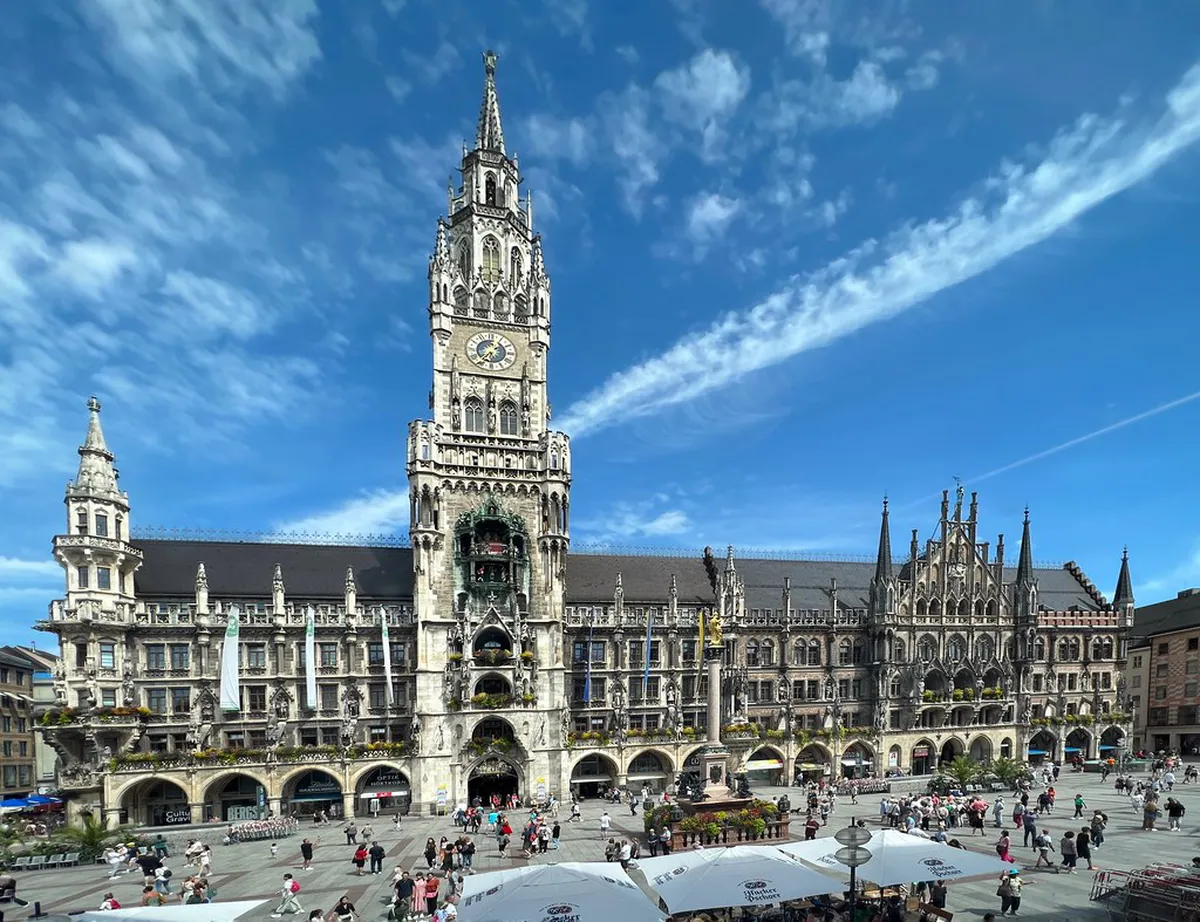
Show times in 2026: 11:00 and 12:00 daily year-round, with an additional 17:00 performance from March through October. There is also a brief 21:00 night chime during the summer months. Arrive ten to fifteen minutes early if you want a clear view from street level. The best free vantage point is the centre of the square near the Mariensäule; avoid standing directly beneath the tower, where the angle makes the upper figures hard to see.
The 11:00 performance draws the largest crowds, often several hundred people deep on busy summer days. The 17:00 show in summer is noticeably less congested and benefits from warm afternoon light if you plan to photograph it. The performance is free from the street.
The Glockenspiel shows at 11:00, 12:00, and 17:00 (March–October) year-round. Arrive 10–15 minutes early for a clear view from the street. The 17:00 summer performance has the warmest light for photography and draws smaller crowds than the 11:00 show.
The Mariensäule and the Fischbrunnen
The Marian Column (Mariensäule) stands in the centre of the square on a base of four bronze figures. Elector Maximilian I had it erected in 1638 to give thanks for Munich surviving the Thirty Years' War. On top of the eleven-metre column stands a golden statue of the Virgin Mary, holding the Christ child and a sceptre, with a crescent moon at her feet. The four figures at the base represent the plagues of the era: a serpent (heresy), a lion (war), a dragon (famine), and a basilisk (pestilence). The column remains an active site of Catholic veneration and occasional public ceremony.
A short walk toward the Beck department store brings you to the Fischbrunnen (Fish Fountain), one of Munich's most beloved local gathering spots. Restored in 1954, the fountain marks where fish were sold at the medieval market. Most visitors walk straight past it, but locals treat it as a fixed meeting point. On Ash Wednesday each year, Munich's mayor and city officials perform the traditional "purse-washing" ritual: they dip their wallets and money bags into the fountain in a tongue-in-cheek ceremony meant to bring financial luck after Carnival. It draws a crowd of locals who find the spectacle both ridiculous and endearing — exactly the kind of living tradition that most travel guides skip entirely.
Scenic viewpoints: St. Peter's Church versus the Town Hall Tower
St. Peter's Church (Peterskirche, known locally as Alter Peter) stands just south of the square and is Munich's oldest parish church. The tower climb involves 306 narrow steps and no elevator, so it demands reasonable fitness. The reward is one of the best views in the city: you look down directly onto Marienplatz, and on days when the Föhn wind blows the Alpine haze clear, the Bavarian Alps are visible on the horizon. Entry costs around €5 in 2026. The interior is worth a look even if you skip the climb — the Baroque altars and ceiling frescoes are genuinely impressive.
The New Town Hall tower offers an elevator option, making it more accessible for families, older visitors, or anyone who prefers not to climb. The view is higher but faces outward across the city rather than down onto the square itself. Choose St. Peter's if photographing Marienplatz is your goal; choose the Town Hall tower if you want a broad panorama of Munich's skyline without the stair effort.
Both viewpoints charge a small entry fee. Avoid paying for either on overcast or hazy days — visibility drops sharply and the Alpine view from St. Peter's disappears entirely.
Nearby landmarks: Frauenkirche, Viktualienmarkt, and Hofbräuhaus
The Frauenkirche (Church of Our Lady) is a five-minute walk northwest from Marienplatz and is the most recognisable symbol of Munich's skyline. Its twin towers, capped by distinctive onion domes, were built in the late 15th century and served as the inspiration for a city ordinance that banned buildings from exceeding the church's 99-metre height for most of the 20th century. Step inside to see the chapels, the tombs of Wittelsbach rulers, and the mysterious "Devil's Footprint" — a black mark on a floor tile near the entrance that comes with a colourful legend about the church's architect outwitting the devil.
The Viktualienmarkt is a five-minute walk south of the square and is Munich's principal open-air food market. Over 100 permanent stalls sell fresh produce, Bavarian cheeses, dried herbs, and regional delicacies. The central beer garden operates year-round (weather permitting) and rotates which Munich brewery supplies the taps. Per Munich's official tourism site, a pretzel, a wedge of Obatzda (a seasoned Camembert spread), and a Masskrug of beer here costs far less than anything on the tourist-facing restaurants ringing Marienplatz itself.
The Viktualienmarkt is open weekdays and Saturdays, typically 08:00–20:00. The beer garden section serves food and drink year-round. Stall vendors offer the best selection and freshest produce early morning (before 11:00). Plan a 30–45 minute visit here after exploring Marienplatz.
Hofbräuhaus is a five-minute walk northeast and requires little introduction. Built in 1589 as a ducal brewery, it seats over a thousand people across its hall and beer garden and is open 365 days a year from 09:00 to midnight. For dining closer to the square, see our guide to the 10 Best Restaurants in Munich (2026) for options that go beyond the obvious tourist traps.
Events on Marienplatz: What happens here throughout the year
Munich's Christkindlmarkt runs through the four weeks of Advent and is the city's largest Christmas market, with over 150 stalls in front of the New Town Hall. Mulled wine, roasted almonds, handmade decorations, and a towering Christmas tree with approximately 3,000 lights define the atmosphere. It is extremely popular — expect dense crowds on weekends and in the evenings. Weekday mornings before 12:00 are the calmest time to visit.
The Stadtgründungsfest (City Foundation Festival) takes place in June to mark Munich's founding in 1158. Two days of live music, historical re-enactments, and food stalls fill the streets around Marienplatz. It is free, family-friendly, and far less commercialised than the Christmas market.
Other recurring events include the FC Bayern Munich championship celebrations on the New Town Hall balcony (when the club wins a title), Christopher Street Day in July, the enthronement of the Carnival prince and princess in January, and the purse-washing at the Fischbrunnen on Ash Wednesday. The square is also occasionally closed for private events or political rallies, so checking the Munich city administration website before a visit saves surprises.
The pedestrian zone: Shopping, eating, and the Weisswurst tradition
Marienplatz is the eastern anchor of Munich's pedestrian zone. Kaufingerstrasse and Neuhauser Strasse run westward toward Karlstor, lined with department stores, international chains, and traditional shops. Sendlinger Strasse runs south and has a slightly more local feel with smaller boutiques. The whole zone is car-free and easy to walk, though it gets genuinely crowded on Saturday afternoons.
The square is also considered the birthplace of the Weisswurst. According to Munich legend, on Carnival Sunday in 1857, a butcher at the inn "Zum Ewigen Licht" on Marienplatz ran out of the correct sheep intestine casings for bratwurst. He improvised with pork casings and poached the sausages in hot water instead of frying them, producing the pale, herb-seasoned white sausage that became a Bavarian staple. The tradition holds that Weisswurst should be eaten before noon — locals say it should not hear the church bells ring twelve. Many restaurants around the square serve it as a breakfast or brunch dish alongside sweet mustard and a Weissbier.
For a meal that goes beyond sausage, our 10 Best Restaurants in Munich (2026) guide covers options at every price point within walking distance of the square. The most tourist-heavy restaurants directly on Marienplatz itself tend to charge a significant premium for location alone.
Advice in the heart of Munich: Practical information
The main Tourist Information office is inside the New Town Hall building, facing Marienplatz. Staff can provide city maps, help with the best things to do in Munich, sell the Munich City Tour Card (which covers public transport and museum discounts), and advise on current events. Opening hours are generally 09:00–19:00 Monday to Friday and 10:00–14:00 on Sundays, though hours shift around public holidays.
Marienplatz is the central hub of Munich's public transport network. All eight S-Bahn lines (S1–S8) and the U3 and U6 subway lines stop at the underground station directly below the square. The station handles around 200,000 passengers daily, making it the busiest interchange in Bavaria. For travel from Munich Airport, the S1 and S8 connect directly to Marienplatz in around 40 minutes. A single-trip ticket within the inner zone costs €3.70 in 2026; a day pass (Tageskarte) for the city zone costs around €9.20 and is worthwhile if you plan more than three trips.
The city's free public WiFi service, M-WLAN, covers the square and surrounding pedestrian zone. Registration is minimal and the connection is sufficient for maps and messaging. During high-attendance events like the Christmas market, speeds drop noticeably — download any offline maps before you arrive. For sensitive transactions, use a VPN or mobile data instead.
Marienplatz is almost always open, as it is a public square with no admission fee. The surrounding streets are at their liveliest between 10:00 and 18:00. Evenings are quieter and can be a pleasant time to see the illuminated New Town Hall facade without the daytime crowds.
Frequently Asked Questions
How do I get to Marienplatz?
Marienplatz is the central hub for Munich's public transport system. You can take any S-Bahn line (S1-S8) or the U3 and U6 subway lines directly to the station. For more details on tickets and routes, see our getting around Munich guide.
What is the best time to see the Glockenspiel?
The 11:00 AM show is the most popular, but the 12:00 PM performance is usually slightly less crowded. During the summer months, the 5:00 PM show offers a great opportunity for photos with softer lighting. Arrive early to secure a spot with a clear view.
Are there public toilets near Marienplatz?
Yes, there are clean public restrooms located in the mezzanine level of the Marienplatz station. You can also find facilities in nearby department stores like Ludwig Beck or Oberpollinger. Most public toilets require a small fee of around 0.50 to 1.00 Euro.
For the bigger picture, see our complete Munich guide. You might also like Nymphenburg Palace and the English Garden.
Marienplatz Munich remains the essential starting point for any visit to the Bavarian capital. From the Glockenspiel show times to the Fish Fountain's Ash Wednesday ritual, the square rewards visitors who look past the obvious. Plan your timing, pick a viewpoint that suits your fitness level, and walk south to the Viktualienmarkt for a more honest taste of Munich than the square's tourist-facing restaurants can offer.
You might also like


Continue reading
More guides you'll find useful